TOPIC 14.8 · STUDY
Double-Slit Interference and Diffraction Gratings
Two slits produce bright fringes where the path difference is a whole number of wavelengths. The fringe spacing grows with wavelength and shrinks when the slits move farther apart. A grating is many evenly spaced slits.
14.8.A
Double slits and gratings
Young's double-slit pattern is evidence that light behaves as a wave. Bright fringes occur when the path difference from the two slits is $\Delta=m\lambda$, with $m=0,1,2,\ldots$. Dark fringes occur when $\Delta=(m+1/2)\lambda$. For small angles the bright-fringe condition is $$d\sin\theta=m\lambda,\qquad y=\frac{m\lambda L}{d}.$$
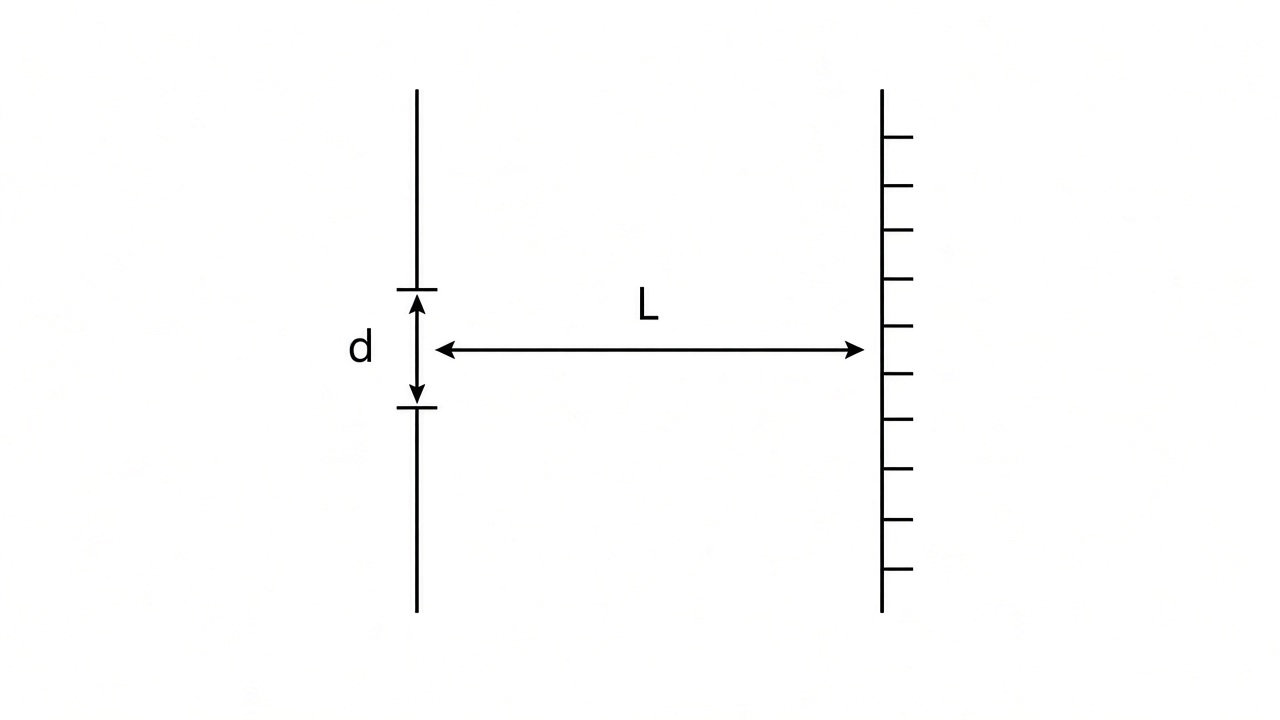
Bright fringes are evenly spaced when the angle is small. The spacing is set by d, lambda, and L.
Example: $d=2.5\times 10^{-4}\,\mathrm{m}$, $\lambda=5.0\times 10^{-7}\,\mathrm{m}$, and $L=2.0\,\mathrm{m}$. The $m=1$ bright fringe is $$y=\frac{(5.0\times 10^{-7})(2.0)}{2.5\times 10^{-4}}=4.0\times 10^{-3}\,\mathrm{m}.$$ At order $m=2$ for that $d$ and $\lambda$, $\sin\theta=m\lambda/d=4.0\times 10^{-3}$. Doubling $d$ halves the fringe spacing. Doubling $\lambda$ doubles it.
Each slit also diffracts. The observed double-slit pattern is interference fringes under a single-slit envelope set by the width of each opening. A diffraction grating is many evenly spaced slits, and the combined pattern is sharper. White light has a white central maximum. Higher orders spread into a spectrum, with red farther from the center than violet because $y$ grows with $\lambda$.
Key points
- Bright fringes: $\Delta=m\lambda$, or $d\sin\theta=m\lambda$.
- Dark fringes: $\Delta=(m+1/2)\lambda$.
- Small angle: $y=m\lambda L/d$.
- Example: $d=2.5\times 10^{-4}\,\mathrm{m}$, $\lambda=5.0\times 10^{-7}\,\mathrm{m}$, $L=2.0\,\mathrm{m}$ gives $y=4.0\times 10^{-3}\,\mathrm{m}$ for $m=1$.
- Larger $d$ packs the fringes closer. Larger $\lambda$ spreads them out.
- Double-slit fringes sit inside a single-slit envelope.
- A grating has many slits. In higher orders, red is farther from the center than violet.
Use the slit separation d for the two-slit fringe spacing. The slit width a sets the diffraction envelope.