Potential Energy FRQ Practice

Responses receive AI feedback against a rubric after submission. Scores are practice estimates.

Question 1 of 5

Scenario A. The table gives elastic potential energy versus compression for an ideal spring. (a) Show that the data are consistent with $U_s=\tfrac12kx^2$ and determine $k$. (b) Determine the work done by the spring as compression decreases from 0.40 m to 0.20 m. (c) Describe the graph that would result from plotting $U_s$ versus $x^2$.

Compression $x$ (m) $U_s$ (J)
0.00 0
0.10 1
0.20 4
0.30 9
0.40 16

Question 2 of 5

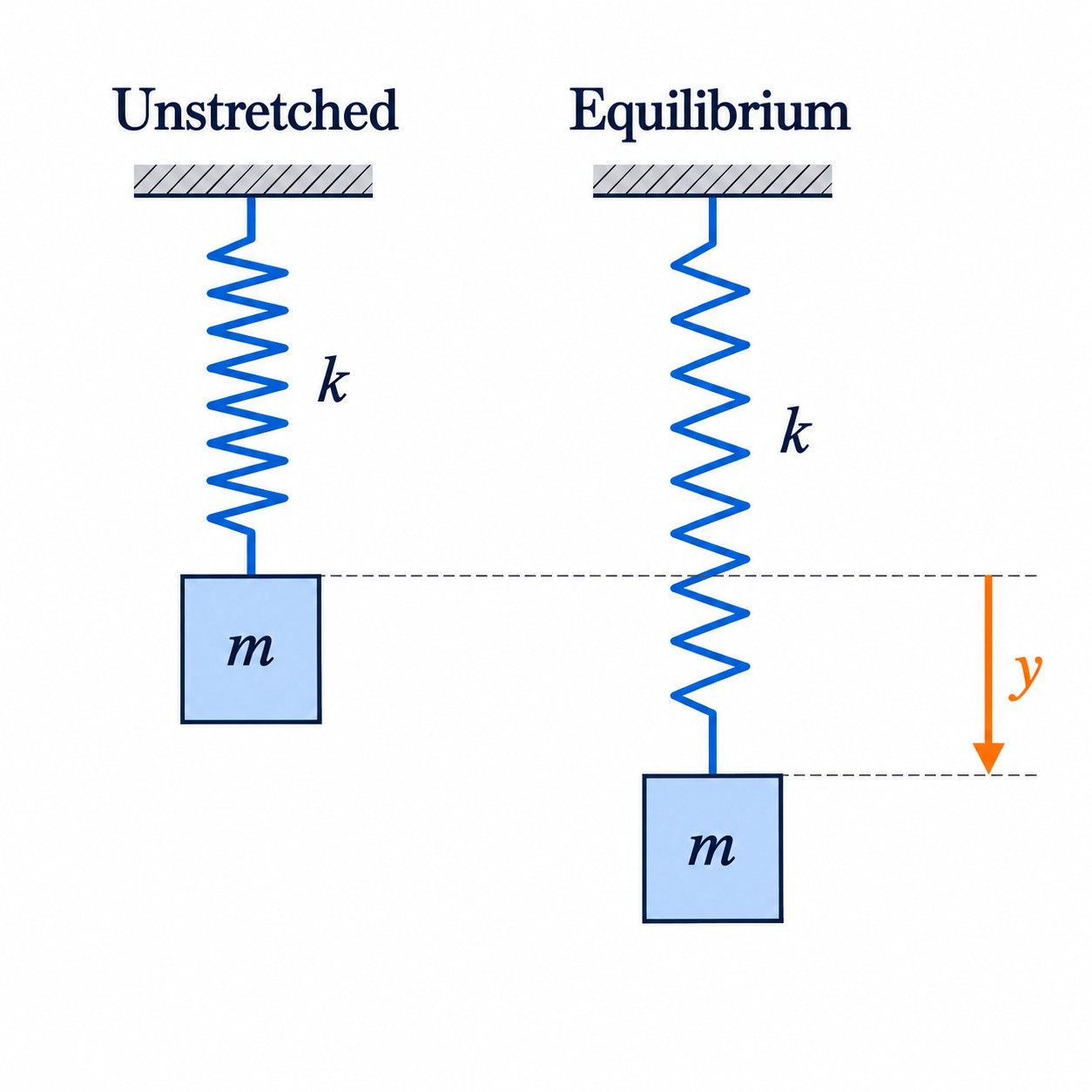
Scenario A. A block of mass $m$ is attached to a vertical spring of spring constant $k$. An external agent slowly lowers the block from the spring's unstretched end to the equilibrium position shown, where the downward displacement from the unstretched position is $y$. The block starts and ends at rest. Express your answers in terms of $m$, $k$, and $g$. (a) Draw a free-body diagram of the block at equilibrium and determine $y$. (b) Calculate the change in elastic potential energy and the change in gravitational potential energy during the lowering. (c) Determine the work done by the external agent and explain the sign of that work. Treat the spring as ideal and massless. At the final equilibrium position the external agent no longer supports the block.

A block of mass m hangs from a vertical spring of constant k at downward displacement y from the unstretched position.

Question 3 of 5

Scenario A. A block is moved slowly from spring compression $x$ to compression $2x$. (a) Determine the change in elastic potential energy. (b) Determine work by the spring. (c) Explain the sign difference. The ideal spring has spring constant $k$, and $x>0$ is measured from its natural length.

Question 4 of 5

Scenario A. Design an experiment to determine an unknown spring constant using a cart launched by the spring on a level, nearly frictionless track, rather than using static force balance. Specify measurements, a graph, its slope, and a consistency check.

Question 5 of 5

Scenario A. Two students choose different zero heights for gravitational potential energy. (a) Show algebraically that both predict the same $\Delta U_g$. (b) Does negative $U_g$ require negative total mechanical energy $K+U_g$? Explain the role of the reference choice. (c) Identify the relevant system.