Phylogeny MCQ Practice

Question 1 of 10

Scenario A. Phylogenetic trees and cladograms are best interpreted as

  1. A. proven, unchangeable facts that never get revised.
  2. B. hypotheses of evolutionary relationships that can be tested and updated with evidence.
  3. C. lists of common names without branching meaning.
  4. D. maps of current geographic ranges only.
Question 2 of 10

Scenario A. A key distinction is that phylogenetic trees calibrated with fossils or molecular clocks

  1. A. can represent amount of change over time, whereas cladograms show branching order without that time calibration.
  2. B. never show branching.
  3. C. cannot use molecular data.
  4. D. are identical to cladograms in showing absolute time scales by definition.

Question 3 of 10

Scenario A. Shared derived characters are useful in building cladograms because they

  1. A. are present in the out-group only by definition.
  2. B. never indicate common ancestry.
  3. C. are inherited from a common ancestor of the clade and help nest related lineages.
  4. D. must be molecular rather than morphological always.

Question 4 of 10

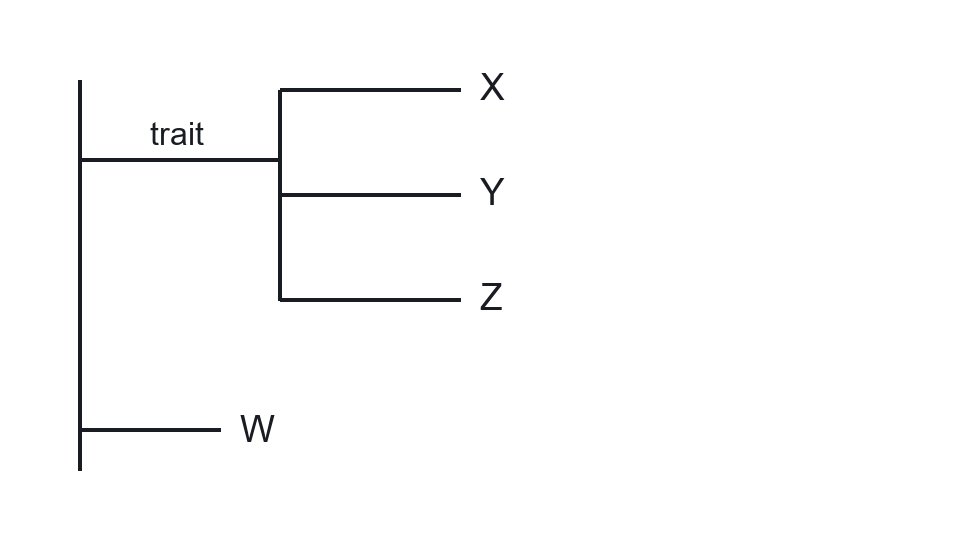
Scenario A. The out-group in a phylogenetic analysis represents

Cladogram with tips W, X, Y, Z and a marked shared trait.
  1. A. the most closely related tip inside the in-group.
  2. B. a species that must share every derived trait.
  3. C. proof that no evolution occurred.
  4. D. a lineage less closely related to the in-group taxa, used for comparison.

Question 5 of 10

Scenario A. Molecular data often improve phylogenetic estimates relative to morphology alone because

Character type Example used in tree building
Morphological Shared derived limb trait
Molecular Shared derived nucleotide substitution
  1. A. large sequence datasets can provide many comparable characters less subject to some morphological convergences.
  2. B. molecules never converge.
  3. C. morphology is never homologous.
  4. D. DNA cannot be aligned.

Question 6 of 10

Scenario A. Traits gained or lost during evolution can be mapped on trees to

  1. A. erase all nodes.
  2. B. infer where characters changed along lineages and help construct relationships.
  3. C. prove dates without fossils or clocks.
  4. D. show that out-groups are always sister to every tip simultaneously.

Question 7 of 10

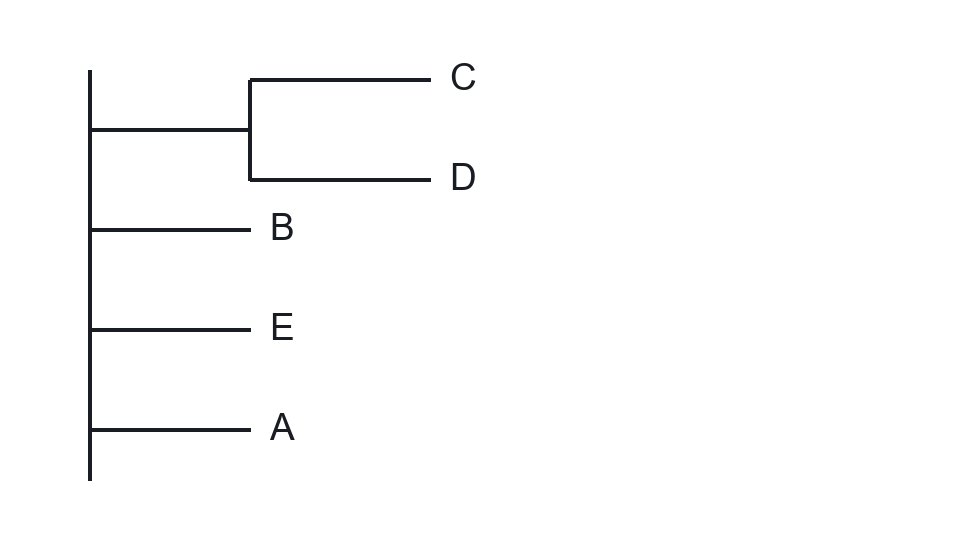
Scenario A. Nodes on a phylogenetic tree represent

Phylogenetic tree with tips A–E and visible nodes.
  1. A. the most recent common ancestor of the lineages that branch from that node.
  2. B. modern species only.
  3. C. geographic barriers only.
  4. D. mutation rates of zero.

Question 8 of 10

Scenario A. Speciation events can be illustrated on trees because

  1. A. trees forbid branching.
  2. B. each tip must be identical.
  3. C. a split into separate lineages at a node corresponds to lineage divergence after reproductive isolation processes.
  4. D. nodes erase ancestry.

Question 9 of 10

Scenario A. Phylogenies can be built from

  1. A. only English common names.
  2. B. morphological similarities of living or fossil species and from DNA or protein sequence similarities.
  3. C. weather forecasts alone.
  4. D. random number tables without characters.

Question 10 of 10

Scenario A. When new sequence data rearrange relationships, scientists should

  1. A. ignore the data to keep old textbooks unchanged.
  2. B. conclude phylogenetics is useless.
  3. C. stop using molecular characters forever.
  4. D. revise the phylogenetic hypothesis to reflect the best current evidence.