TOPIC 7.10 · STUDY
Speciation
Speciation occurs when populations become reproductively isolated. Under the biological species concept, a species is a group that can interbreed and produce viable, fertile offspring. Change may be gradual or punctuated, and it may be divergent or convergent. Allopatric speciation uses geographic isolation. Sympatric speciation occurs where ranges overlap. Pre-zygotic barriers block zygote formation, and post-zygotic barriers act after a zygote forms.
7.10.A
Reproductive isolation and species
Speciation occurs when two populations become reproductively isolated from each other. If gene flow continues and individuals keep producing viable, fertile offspring together, they remain one species. Isolation is the break that lets them become separate species.
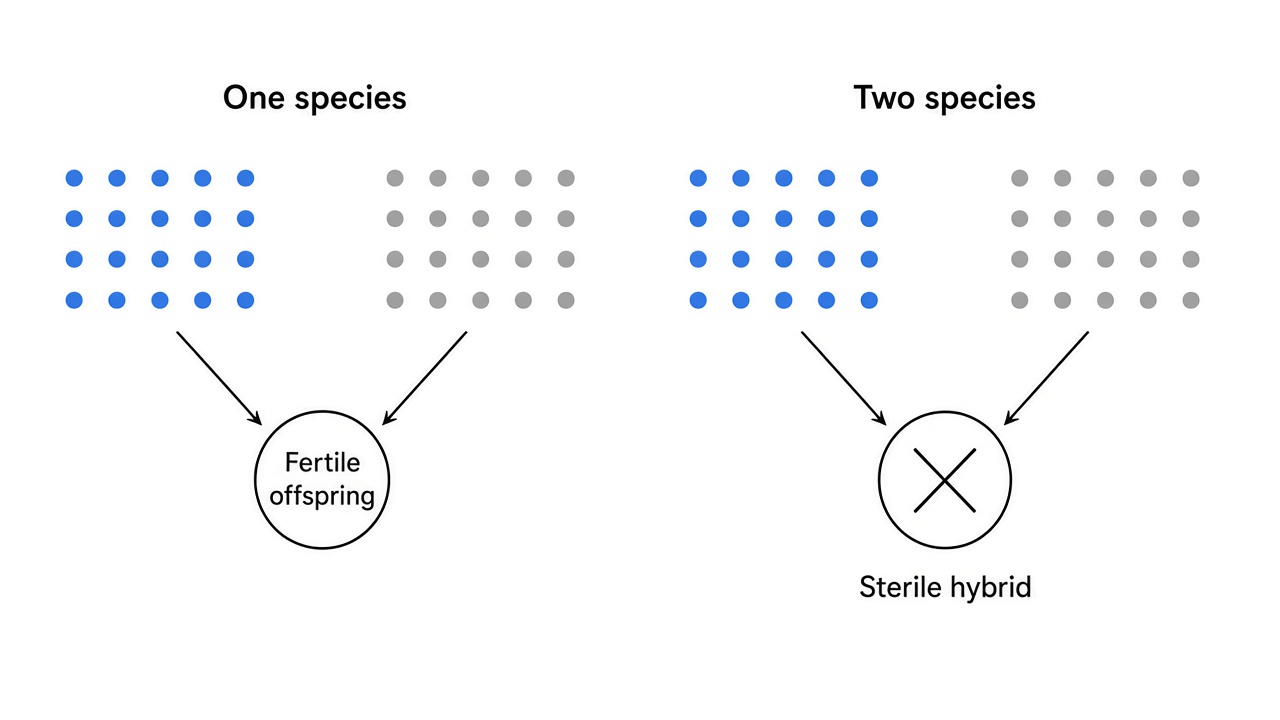
Fertile offspring fit one species under the biological species concept. A sterile hybrid means the parents are reproductively isolated.
The biological species concept is a commonly used definition for sexually reproducing organisms. A species is a group capable of interbreeding and exchanging genetic information to produce viable, fertile offspring. Two populations that look alike are still separate species under this concept if they cannot produce viable, fertile offspring together. Sterile hybrids are evidence of that isolation. The concept is not a claim that every morphological difference is a species boundary, and it cannot be applied by breeding tests to organisms known only as fossils.
7.10.B
Pace and pattern of change
Punctuated equilibrium is evolution that occurs rapidly after a long period of stasis. Gradualism is evolution that occurs slowly over hundreds of thousands or millions of years. A fossil series with long unchanged stretches and then a short burst fits punctuated equilibrium. A series of steady small changes fits gradualism.
Divergent evolution occurs when adaptation to new habitats results in phenotypic diversification. Speciation rates can be especially rapid during adaptive radiation as new habitats become available. Convergent evolution occurs when similar selective pressures produce similar phenotypic adaptations in different populations or species. Those similar traits are not, by themselves, evidence of a recent shared ancestor.
7.10.C
Where and how isolation happens
Allopatric speciation occurs in populations that are geographically isolated. A barrier that stops movement reduces gene flow, and the separated populations can diverge. If they later meet and still cannot produce viable, fertile offspring, speciation has occurred. Sympatric speciation occurs in populations with geographic overlap: a reproductive barrier arises even though the individuals live in the same area. Hawaiian Drosophila and Caribbean Anolis are illustrative cases of divergence after populations spread into new island habitats. Apple maggot flies, Rhagoletis, are an illustrative case of a reproductive split between host plants while ranges still overlap.
Pre-zygotic and post-zygotic mechanisms maintain reproductive isolation and prevent gene flow. Pre-zygotic barriers prevent fertilization, so no zygote forms. Individuals may breed at different times, use different courtship signals, or have gametes that do not fuse. Post-zygotic barriers act after a zygote has formed. The hybrid may die during development, or it may live and be sterile. Pre-zygotic isolation is not the same process as genetic drift, and post-zygotic isolation is not limited to adult hybrids.
| Pattern | Geography | What blocks gene flow |
|---|---|---|
| Allopatric speciation | Populations are separated by a barrier | Individuals do not meet, so they do not interbreed |
| Sympatric speciation | Ranges overlap | A reproductive barrier arises in the same area |
| Pre-zygotic barrier | Either geography | No zygote forms |
| Post-zygotic barrier | Either geography | A zygote forms, but hybrids die, are sterile, or leave few descendants |
Key points
- Speciation requires reproductive isolation that stops gene flow.
- The biological species concept: interbreeding that produces viable, fertile offspring.
- Sterile or inviable hybrids mean the parents are separate species under that concept.
- Gradualism is slow change. Punctuated equilibrium is rapid change after stasis.
- Divergent evolution and adaptive radiation spread phenotypes into new habitats. Convergent evolution produces similar phenotypes under similar pressures.
- Allopatric speciation uses geographic isolation. Sympatric speciation occurs where ranges overlap.
- Pre-zygotic barriers block zygote formation. Post-zygotic barriers act after the zygote forms.
Looking different is not the biological species concept. The test is viable, fertile offspring.