TOPIC 7.11 · STUDY
Variations in Populations
The amount of genetic variation in a population affects how that population responds to environmental pressure. Populations with little diversity are more likely to decline or go extinct when conditions change. Diverse populations are more likely to include individuals that withstand the new pressure. An allele that helps in one environment can be harmful in another.
7.11.A
Diversity and environmental stress
The level of variation in a population affects how that population responds when the environment changes. Species and populations with little genetic diversity are at risk of decline or extinction. Genetically diverse populations are more resilient because they are more likely to contain individuals that can withstand the new pressure.
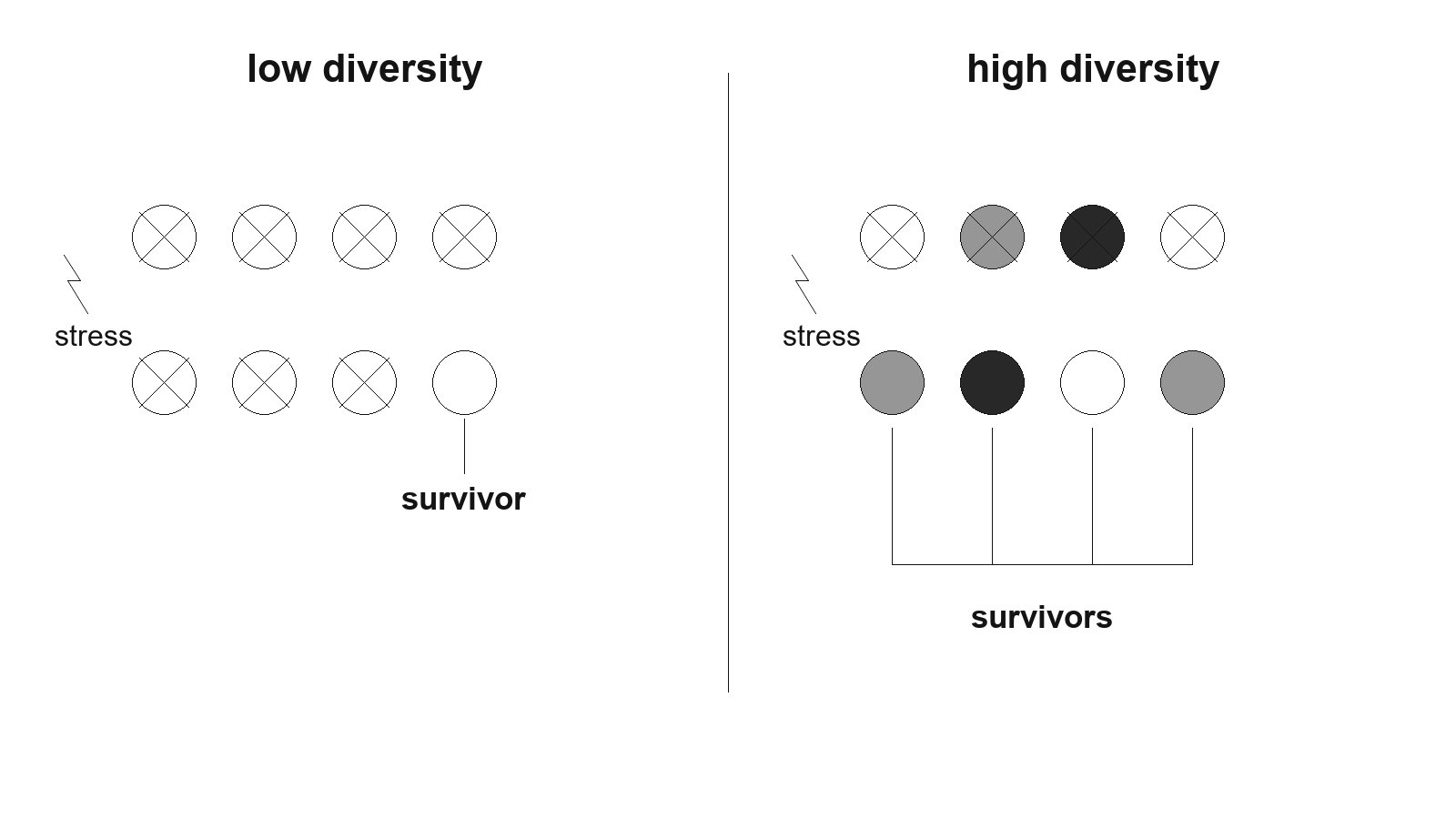
The same stress leaves one survivor when diversity is low and several survivors of more than one type when diversity is high.
A population that has passed through a severe reduction can lose alleles. If few alleles remain, most individuals may share the same susceptibility. A disease or a climate shift can then cause a steep decline because resistant genotypes are rare or absent. Keeping several lineages, or several alleles, raises the chance that at least some individuals survive a later stress. California condors, black-footed ferrets, and prairie chickens are illustrative cases of low-diversity risk. Potato blight and corn rust are illustrative cases of crops in which shared susceptibility lets a pathogen spread.
Alleles that are adaptive in one environmental condition may be deleterious in another because selective pressures differ. A cold-favored allele can reduce performance in heat. Diversity preserves alleles that may become useful if conditions shift again. Antibiotic resistance makes the same point from the other direction: in a diverse bacterial population, not every individual is susceptible, so treatment can leave resistant individuals that then increase.
Key points
- Genetic diversity affects whether a population can respond to environmental change.
- Low diversity raises the risk of decline or extinction under a new stress.
- A diverse population is more likely to include individuals that withstand the pressure.
- Shared susceptibility, as in some crop diseases, lets a pathogen spread widely.
- An allele that is helpful in one environment can be harmful in another.
- Not every individual in a diverse population is susceptible to a given treatment or disease.
Diversity does not guarantee that every individual survives. It raises the chance that some heritable variants do.