TOPIC 7.12 · STUDY
Origins of Life on Earth
Geological evidence places the origin of life after Earth became hospitable and by the time of the earliest fossils. Earth formed about 4.6 billion years ago, conditions were too hostile for life until about 3.9 billion years ago, and fossil evidence of life dates to about 3.5 billion years ago. The RNA world hypothesis says early genetic continuity came from RNA replication by base-pairing, without genetically encoded proteins as catalysts.
7.12.A
Dates and the RNA world
The origin of life on Earth is supported by scientific evidence. Geological evidence constrains when life could have begun. Earth formed about 4.6 billion years ago. The environment was too hostile for life until about 3.9 billion years ago, and the earliest fossil evidence for life dates to about 3.5 billion years ago. Together these dates give a plausible window: after conditions became hospitable, and by the time of those fossils. Formation of the planet is not the origin of life.
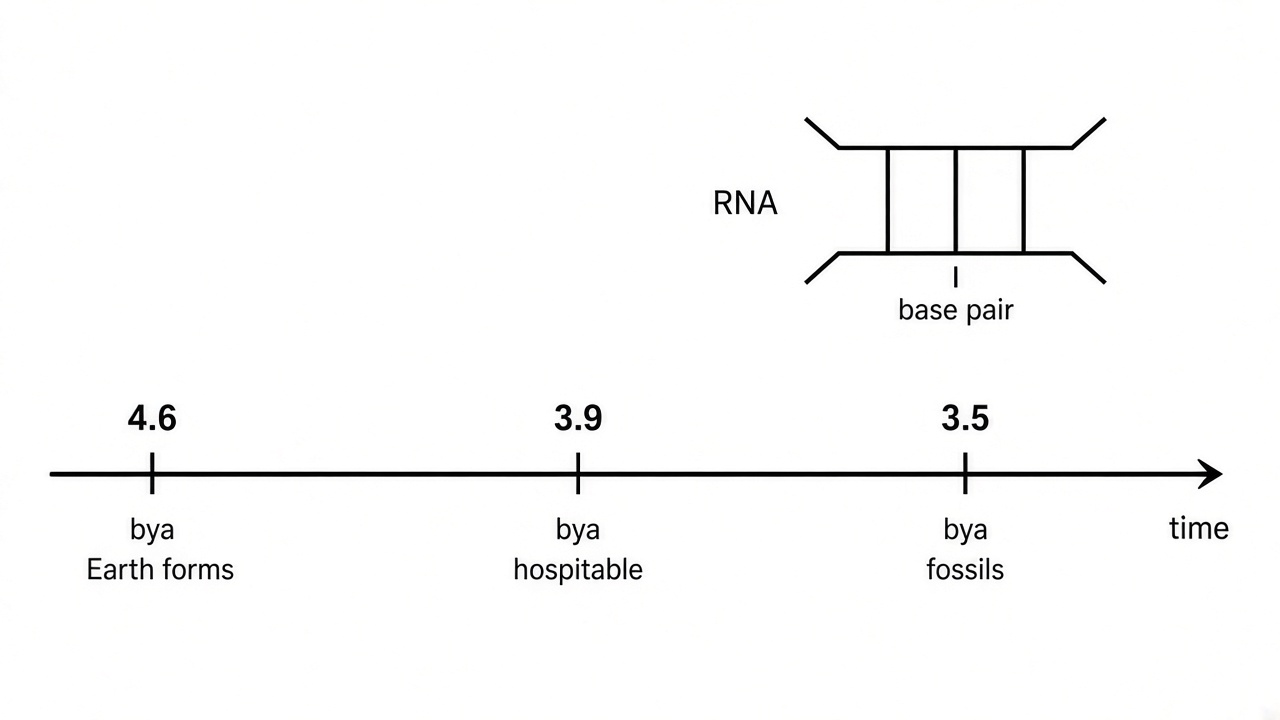
bya means billion years ago. The three dates bound when life could begin. The RNA ladder is the molecular hypothesis, not a fossil dated to 3.5 bya.
The RNA world hypothesis proposes that RNA could have been the earliest genetic material. It uses three assumptions. Genetic continuity was assured by the replication of RNA. Base-pairing is necessary for that replication. Genetically encoded proteins were not the catalysts. Under those assumptions, RNA could both store information and be copied. A test that finds RNA templates replicating by base-pairing without genetically encoded protein enzymes supports that capacity. A test that requires those protein enzymes does not match the hypothesis.
A geological null prediction is that fossils of life should be absent from the hostile interval, before about 3.9 billion years ago. Fossils by about 3.5 billion years ago, and none from the earlier hostile window, fit the dating model. Geology addresses when and under what planetary conditions life could arise. The RNA world addresses what molecular system could store and copy information. The two lines answer different parts of the origin question.
| Evidence | Claim it supports |
|---|---|
| Earth formed about 4.6 billion years ago | The planet is older than life. The surface was not yet suitable. |
| Hostile until about 3.9 billion years ago | Life is not expected before conditions allowed it. |
| Fossils by about 3.5 billion years ago | Life had originated by the time of those fossils. |
| RNA replication by base-pairing | Early genetic continuity need not have used encoded protein catalysts. |
Key points
- Earth formed about 4.6 billion years ago. That date is not the origin of life.
- The surface was too hostile for life until about 3.9 billion years ago.
- The earliest fossil evidence of life dates to about 3.5 billion years ago.
- The plausible origin window is after about 3.9 and by about 3.5 billion years ago.
- The RNA world hypothesis: RNA replication provided genetic continuity.
- Base-pairing is required for that replication, and genetically encoded proteins were not the catalysts.
A claim that life began when Earth formed overstates the timing. The hostile interval comes first.