TOPIC 8.1 · STUDY
Responses to the Environment
Organisms respond to internal and external change with behavior and physiology, and they exchange information that can change behavior. Signals and cooperative behavior can raise survival and reproductive success. Specific neural, hormonal, and molecular mechanisms are outside this topic.
8.1.A
Responses to internal and external change
An organism responds to a change inside its body or in its surroundings with a behavioral change, a physiological change, or both. The cue may be light, moisture, temperature, a predator, or a chemical from another organism. Link the cue to the response. A named neural circuit, hormone sequence, or photoreceptor protein is outside the exam.
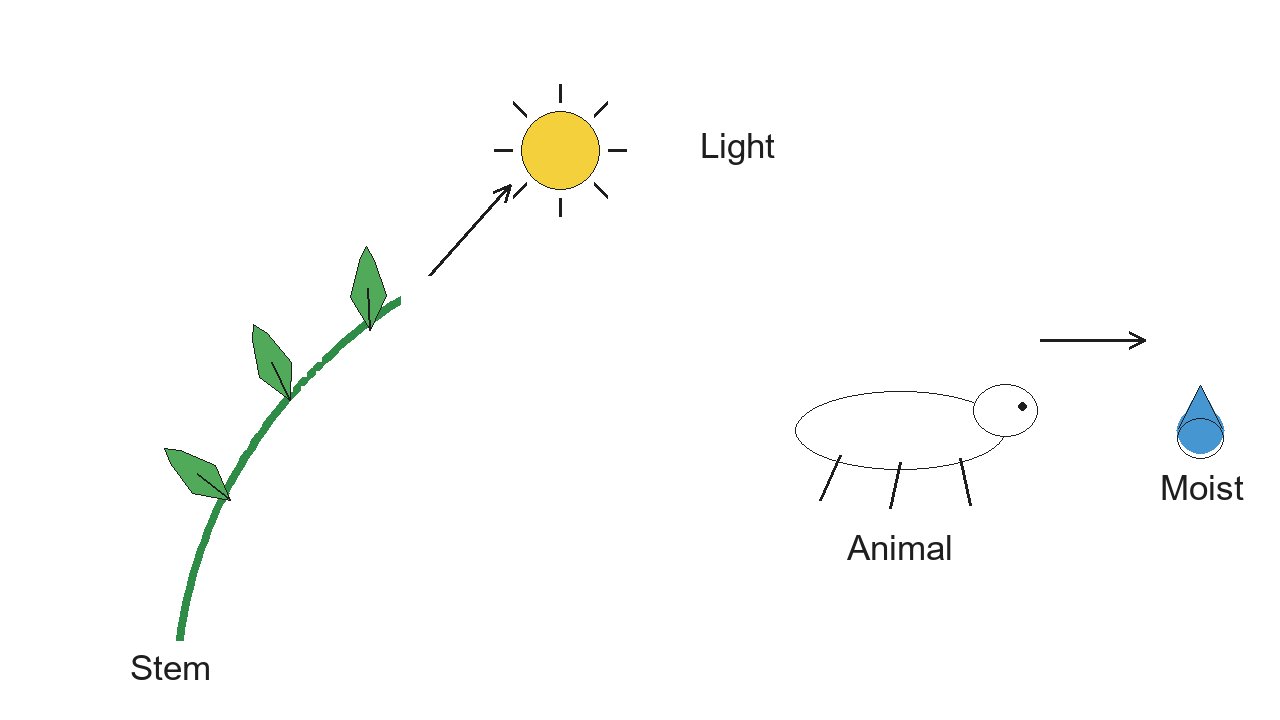
The stem curves toward light, a growth response. The animal moves toward moisture, a behavioral response. Each change is tied to an external cue.
Day length can change when a plant flowers. That is a response to an external cue, not a schedule that ignores the environment. Directed movement toward or away from a stimulus is taxis. A change in speed or turning, without a fixed direction, is kinesis. Activity at night and rest by day is a timing response to the light-dark cycle. A rise in heart rate after a sudden stimulus is a physiological response. Fight-or-flight is the same pattern: a cue arrives, and behavior or body function changes. The cellular steps are out of scope.
Organisms also pass information, and that exchange can change behavior. An alarm signal can send neighbors into hiding. After herbivory, a plant may release a chemical cue, and a neighbor may then raise its defenses. To test a response, change one cue and measure the outcome. The independent variable is the cue you set, such as light from one side or a temperature difference. The dependent variable is what you record, such as stem angle or where animals settle. A control keeps the other conditions the same and removes that cue, or makes it uniform, so a difference can be tied to the cue.
8.1.B
Communication, fitness, and cooperation
Communication uses visual, audible, tactile, electrical, or chemical signals. A signal matters when it changes what another organism does and can change who survives or who reproduces. Animals use signals to show dominance, find food, hold a territory, or gain a mate. Flower color, a courtship display, and a bird song are signals of this kind. Parents that respond to offspring, and animals that recruit others to food, are using communication that can raise reproductive success. The mechanism of any one signal is out of scope.
Fitness favors innate and learned behaviors that increase survival or reproduction. A song dialect learned in one region can attract mates there. The behavior does not have to be inborn to be favored. Cooperative behavior tends to raise the fitness of the individuals that take part and the survival of the population. Pack hunting, herds, flocks, schools, insect colonies, and shared predator warnings are examples. Kin selection is one reason cooperation can persist when relatives share the benefit. The social details of any one species are out of scope.
Key points
- A response links a cue to a behavioral or physiological change. Named pathways are out of scope.
- Taxis is directed movement. Kinesis is a change in speed or turning. Both answer an external cue.
- Information from another organism can change behavior, as with an alarm signal or a plant cue after herbivory.
- In a test of a response, the cue is the independent variable and the measured response is the dependent variable.
- Signals used for mating, territory, dominance, or finding food can change reproductive success.
- Innate and learned behaviors are both favored when they raise survival or reproduction.
- Cooperation, including group hunting and shared warnings, tends to raise individual fitness and population survival.
State the cue, the response, and, when asked, the effect on survival or reproduction. Do not memorize a circuit for phototropism, taxis, or fight-or-flight.