TOPIC 1.5 · STUDY
Lipids
Lipids are typically nonpolar, hydrophobic molecules whose jobs follow from how their parts are assembled. Saturated fatty acids have only single bonds between carbons. Unsaturated fatty acids have double bonds that kink the chain and make the lipid more liquid. Fats store energy, steroids include hormones, cholesterol stabilizes animal membranes, and phospholipids form bilayers.
1.5.A
Structure and function of lipids
Lipids are not one repeating chain of identical monomers the way a polysaccharide is. Structure and function come from how the parts are put together. Most of a lipid is a hydrocarbon framework, so lipids are typically nonpolar and hydrophobic: they do not mix freely with water. Fatty acid tails show the saturated and unsaturated difference. A saturated fatty acid has only single bonds between carbon atoms. The chain stays relatively straight and can pack closely against neighboring tails. An unsaturated fatty acid has at least one carbon-carbon double bond, and that double bond kinks the chain. More double bonds make the lipid more unsaturated, and a more unsaturated lipid is more liquid at room temperature. Adding hydrogen across the double bonds removes kinks, raises saturation, and makes the fat more solid.
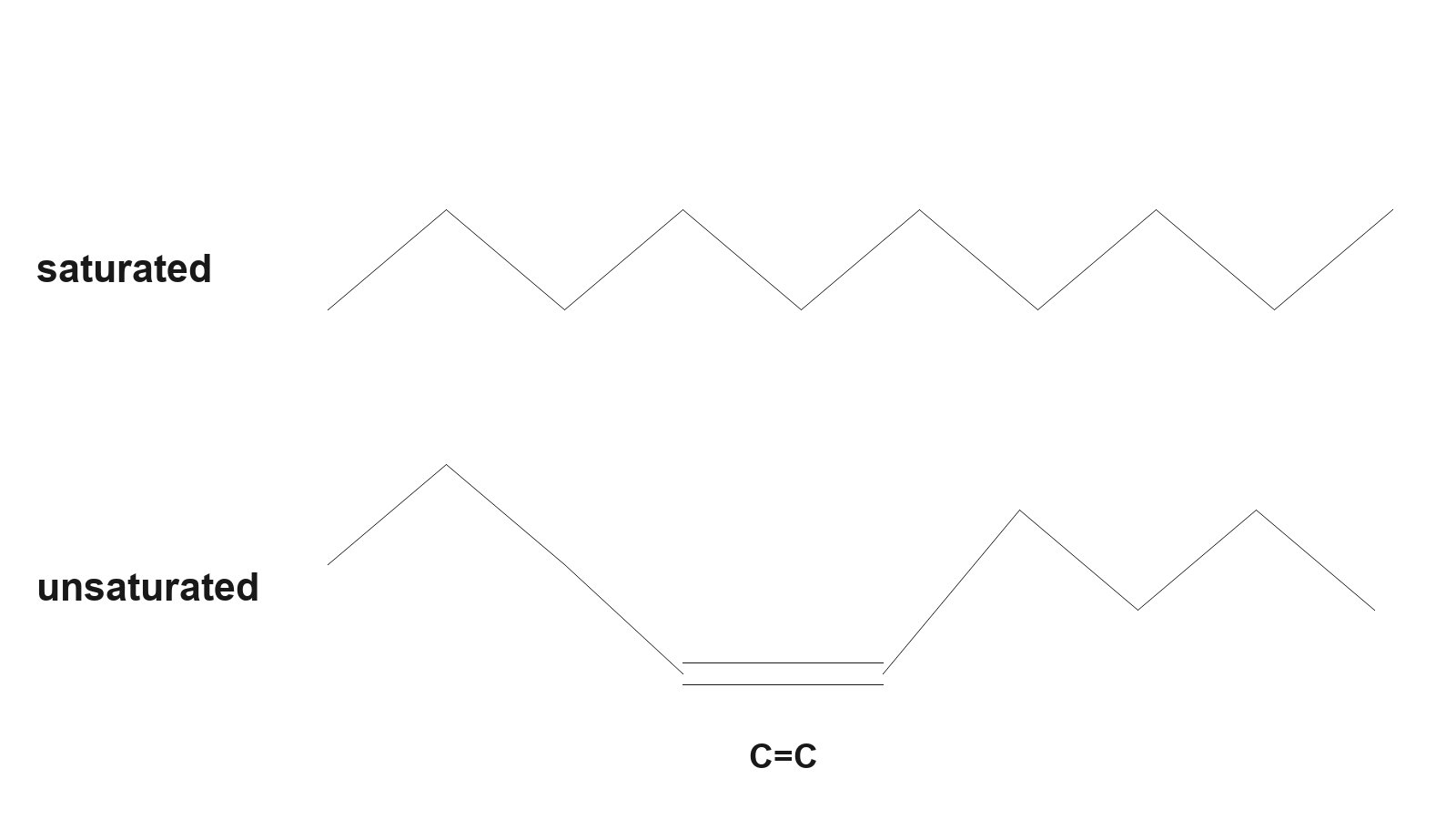
The upper chain is saturated: a straight zigzag of single bonds. The lower chain is unsaturated: the C=C double bond is where the chain bends into a kink.
| Lipid | Role in living systems |
|---|---|
| Fats | Store energy and support cell function. In some mammals they also insulate. |
| Steroids | Include hormones that support growth, development, energy metabolism, and homeostasis. |
| Cholesterol | Gives animal cell membranes essential structural stability. |
| Phospholipids | Group into the bilayers of plasma membranes and other cell membranes. |
A phospholipid still has hydrophobic fatty acid tails. Its head includes phosphate and interacts with water, so the head is hydrophilic. In water, heads face the water and tails turn inward, away from water. That assembly is the bilayer. Cholesterol's role in an animal membrane is structural stability. If the fatty acid tails in a bilayer become more saturated, they pack more tightly and the membrane tends to be less fluid at the same temperature. The hydrophobic tails are what keep the bilayer organized. This topic stops at that assembly. It does not cover protein channels or how substances cross the membrane.
Key points
- Lipids are typically nonpolar and hydrophobic. Function follows how the parts are assembled.
- Saturated fatty acids have only single bonds between carbons, so the tails are relatively straight.
- Unsaturated fatty acids have at least one carbon-carbon double bond, which kinks the tail.
- More double bonds mean more unsaturated and more liquid at room temperature.
- Fats store energy and can insulate. Steroid hormones support growth, metabolism, and homeostasis.
- Cholesterol stabilizes animal cell membranes. Phospholipids form bilayers, heads toward water and tails inward.
A phospholipid is still a lipid even though its head meets water. The hydrophobic tails are the part that turns away from water and builds the interior of the bilayer.