TOPIC 1.6 · STUDY
Nucleic Acids
DNA and RNA store information in the order of nucleotide monomers. Each nucleotide has a five-carbon sugar, a phosphate, and a nitrogenous base. DNA is usually an antiparallel double helix with adenine paired to thymine and cytosine paired to guanine. RNA is usually a single strand with ribose and uracil.
1.6.A
Structure of DNA and RNA
Biological information in a nucleic acid is the sequence of nucleotides. Every nucleotide has three parts: a five-carbon sugar, a phosphate group, and a nitrogenous base. The sugar is deoxyribose in DNA and ribose in RNA. The bases for this course are adenine, thymine, guanine, cytosine, and uracil. A strand is linear and has two different ends. The 5' end carries the phosphate on the 5' carbon of the sugar. The 3' end has a hydroxyl on the 3' carbon. During synthesis, the next nucleotide is added to the 3' end, and a covalent bond forms along the growing strand. That covalent sugar-phosphate chain is the backbone. The full structural formula of each base or sugar is not required.
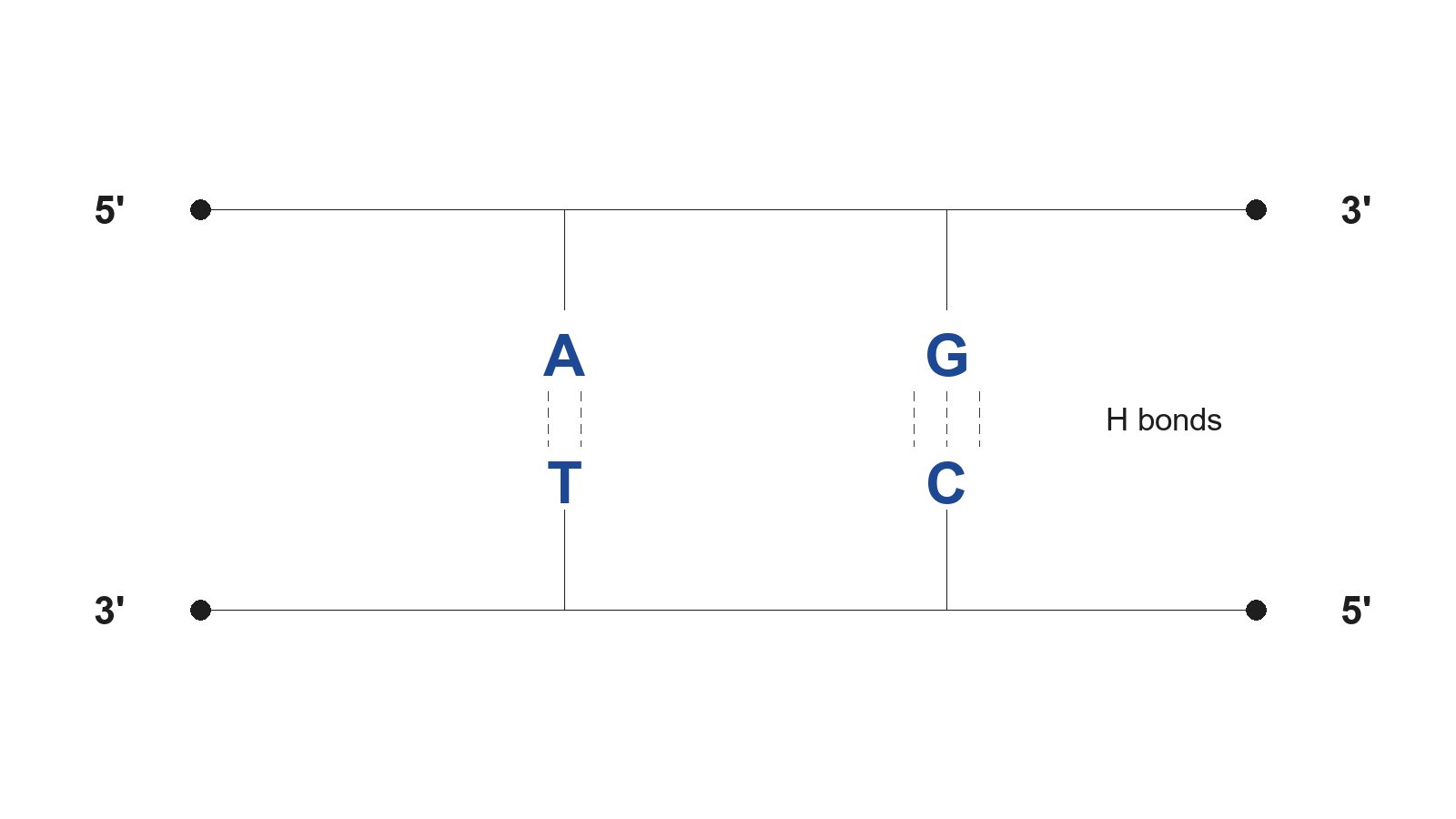
The top strand runs 5' to 3' from left to right. The bottom strand runs the opposite way, 3' to 5' from left to right. Dashed lines are hydrogen bonds: two between A and T, and three between G and C. Solid lines attach the bases to the backbone.
DNA is an antiparallel double helix. One strand runs 5' to 3' in one direction, and the partner strand runs 5' to 3' the other way. The figure shows that opposite orientation and the base pairs, not a twisted ladder. Adenine pairs with thymine, and cytosine pairs with guanine, through hydrogen bonds. In RNA, adenine pairs with uracil. Hydrogen bonds hold complementary DNA strands together. They are easier to disrupt than the covalent bonds of the backbone, so the strands can come apart while each strand stays intact. In double-stranded DNA the pairs set the amounts. If 22 percent of the bases are adenine, about 22 percent are thymine, and the remaining 56 percent is split equally between guanine and cytosine, about 28 percent each. A single RNA strand does not have to match that way. It has no partner strand, and it uses uracil instead of thymine.
| Feature | DNA | RNA |
|---|---|---|
| Five-carbon sugar | Deoxyribose | Ribose |
| Distinctive base | Thymine | Uracil |
| Typical form | Double stranded | Single stranded |
| Shared features | Nucleotide sequence, 5' and 3' ends, covalent backbone | Nucleotide sequence, 5' and 3' ends, covalent backbone |
Key points
- A nucleotide is a five-carbon sugar, a phosphate, and a base: adenine, thymine, guanine, cytosine, or uracil.
- DNA uses deoxyribose and thymine. RNA uses ribose and uracil.
- A strand has a 5' phosphate end and a 3' hydroxyl end. New nucleotides are added at the 3' end.
- DNA is an antiparallel double helix. A pairs with T, and C pairs with G, by hydrogen bonds.
- In RNA, adenine pairs with uracil. RNA is typically single stranded.
- In double-stranded DNA, the percent of A matches T, and the percent of G matches C.
- Atom-by-atom structures of individual nucleotides are not required.
Hydrogen bonds pair the bases across the two strands. Covalent bonds link nucleotides along one strand. Separating the pairs opens the helix. Cutting the backbone breaks the strand.