TOPIC 1.7 · STUDY
Proteins
Proteins are chains of amino acids joined by peptide bonds. The sequence is the primary structure and determines the shape. Backbone hydrogen bonds make helices and sheets. R-group interactions fold each chain, and some proteins work only when more than one chain assembles.
1.7.A
Structure and function of proteins
A protein is a linear chain of amino acids. The link is a covalent peptide bond between the carboxyl group ($-\mathrm{COOH}$) of one amino acid and the amine group ($-\mathrm{NH_2}$) of the next. Each amino acid has a central carbon bonded to a hydrogen atom, a carboxyl group, an amine group, and a variable R group. The R group is the part that changes from one amino acid to another. For this course, R groups are hydrophobic (nonpolar), hydrophilic (polar), or ionic. Interactions among those R groups set the structure and function of that region of the protein. The order of amino acids is the primary structure, and that sequence determines the overall shape. The structural formula of each individual amino acid is not required.
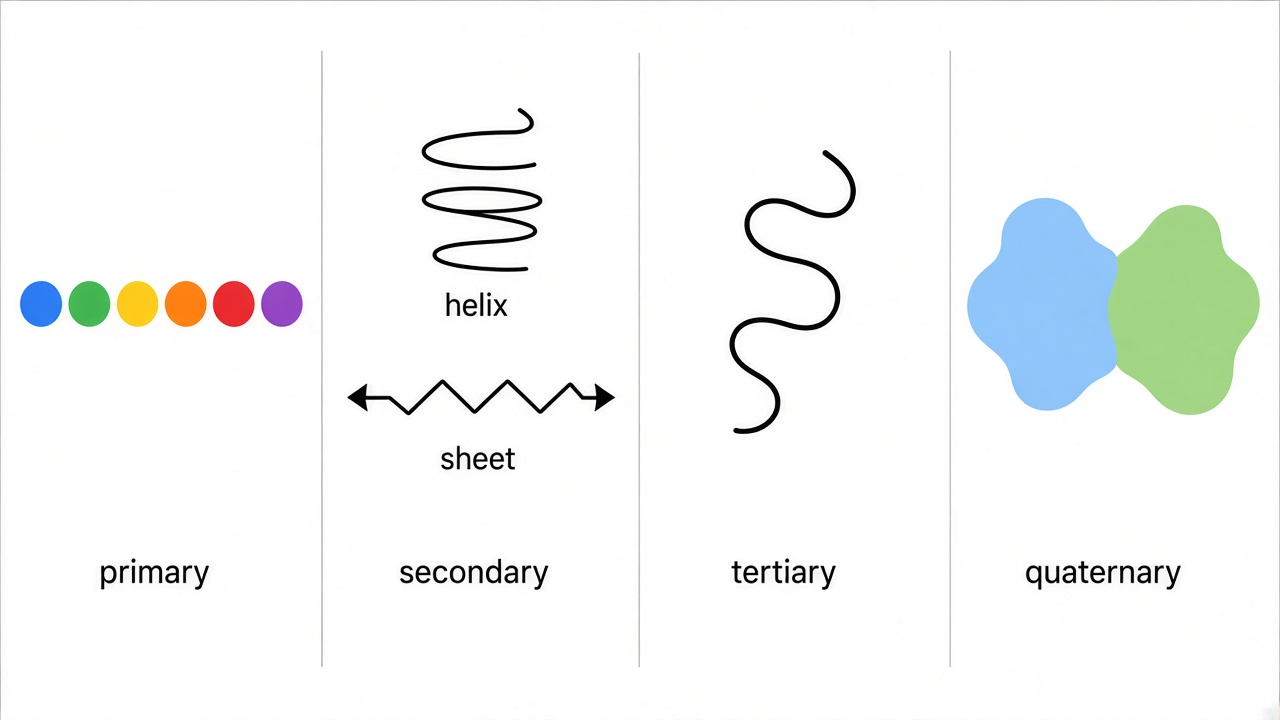
Primary structure is the amino acid order, drawn as a row of beads. Secondary structure is local folding: a coil labeled helix and a zigzag labeled sheet. Tertiary structure is one whole chain folded. Quaternary structure is two folded chains fitted together.
Secondary structure is local folding from interactions along the polypeptide backbone, especially hydrogen bonds. The common shapes are the alpha helix and the beta-pleated sheet. Tertiary structure is the three-dimensional shape of a single chain. It comes from hydrogen bonds, hydrophobic interactions, ionic interactions, and disulfide bridges. A disulfide bridge is a covalent link between sulfur-containing R groups. Quaternary structure exists only when two or more polypeptide chains associate. A protein that carries oxygen in red blood cells, built from four chains, loses that assembled function if the chains cannot come together, even when each chain is still a complete sequence. All four levels determine function. A protein with only one chain has no quaternary level, and the other three levels still determine what it does.
Heat can unfold a protein by disrupting the weaker folding interactions while the peptide bonds stay intact, so the primary sequence remains. The unfolded protein usually loses its function because the shape is gone. Changing one buried hydrophobic R group to a charged ionic R group pulls that spot toward water and can distort the tertiary fold. Breaking disulfide bridges can loosen tertiary structure without hydrolyzing the chain into separate amino acids. The sequence is still there. The fold is not.
Key points
- Peptide bonds covalently join the carboxyl group of one amino acid to the amine group of the next.
- Every amino acid has a central carbon, a hydrogen, a carboxyl group, an amine group, and an R group.
- R groups are hydrophobic, hydrophilic, or ionic. Their interactions shape that region of the protein.
- Primary structure is the amino acid sequence. It determines the overall shape.
- Secondary structure is local backbone folding: alpha helices and beta-pleated sheets, held by hydrogen bonds.
- Tertiary structure is one chain's three-dimensional shape, from hydrogen bonds, hydrophobic and ionic interactions, and disulfide bridges.
- Quaternary structure is the assembly of multiple polypeptide chains. Every level the protein has helps determine its function.
Peptide bonds define the sequence. Hydrogen bonds, hydrophobic clustering, ionic attractions, and disulfide bridges fold the chain. A treatment can break the folding interactions and leave the amino acid sequence in place.