TOPIC 8.5 · STUDY
Community Ecology
Community structure is the species present and their diversity. Simpson's diversity index is 1 minus the sum of the squared proportions, so even abundances score higher than a community dominated by one species. Competition, predation, and symbioses change who gets energy and matter, and they can reshape the community over time.
8.5.A
Composition and diversity
A community is a set of interacting populations of different species. Its structure is species composition and species diversity. Composition is which species are there. Two forests that share no tree species differ in composition even before anyone computes an index. Diversity also uses how many species there are and how even their abundances are.
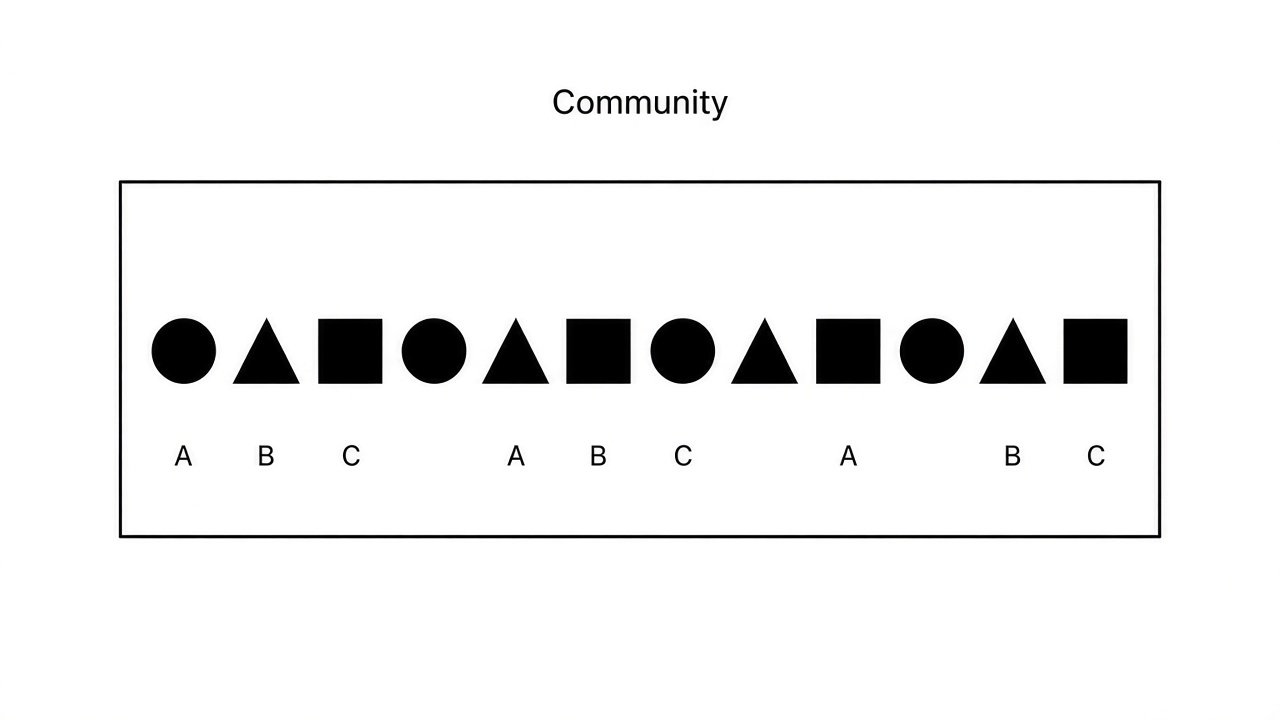
The three shapes stand for three species living together. Even counts score a higher diversity index than the same species with one count much larger than the others.
Simpson's diversity index is $1-\sum\left(\frac{n}{N}\right)^{2}$. For each species, $n$ is its count and $N$ is the total count of all individuals. Square each proportion, add those squares, and subtract the sum from 1. A higher value means higher diversity.
Four species with 6 individuals each: $N=24$, each proportion is $0.25$, and $\sum\left(\frac{n}{N}\right)^{2}=4\times(0.25)^{2}=0.25$. The index is $1-0.25=0.75$. The same total split as 18 and 6 gives $(18/24)^{2}+(6/24)^{2}=0.5625+0.0625=0.625$, so the index is $1-0.625=0.375$. The uneven community is less diverse even though both samples have 24 individuals. If one species accounts for every individual, the sum of squares is 1 and the index is 0. Two communities can share the same richness and still differ in diversity when evenness differs.
8.5.B
Interactions that shape a community
Communities change over time because the populations interact. Those interactions decide how populations reach energy and matter. The effect on each partner can be positive or negative.
| Interaction | Effect on the partners |
|---|---|
| Competition | Both are harmed |
| Predation | The predator gains and the prey is harmed |
| Parasitism | The parasite gains and the host is harmed |
| Mutualism | Both gain |
| Commensalism | One gains and the other is unaffected |
Niche partitioning reduces overlap in how species use a resource, which can let competitors persist together. A trophic cascade is an indirect effect through the food web. A predator that suppresses a strong consumer can increase the organisms that consumer had been eating, so community composition changes. Predator and prey numbers can also rise and fall in turn: more predators can reduce prey, and scarce prey can then reduce predators. Cooperation can change access to resources as well. You need the sign of each effect and how it can change who persists, not the case history of one shoreline.
Key points
- Composition is which species are present. Diversity also includes richness and evenness.
- Simpson's index is $1-\sum(n/N)^{2}$. Square each proportion, then subtract the sum from 1.
- Even counts of 6, 6, 6, and 6 give $0.75$. Counts of 18 and 6 give $0.375$.
- An index of 0 means one species makes up the whole sample.
- Competition harms both partners. Predation and parasitism help one partner and harm the other.
- Mutualism helps both. Commensalism helps one and leaves the other unaffected.
- Niche partitioning and trophic cascades change who persists and who gets energy and matter.
Do not report the sum of the squared proportions as the diversity index. The index is 1 minus that sum. A larger index means more diversity.