TOPIC 8.4 · STUDY
Effect of Density on Populations
Carrying capacity is the population size that the available resources can support. Density-dependent limits, such as competition, and density-independent limits, such as a storm, move growth from the exponential pattern toward logistic growth. In the logistic model the growth rate is zero at carrying capacity and negative when the population is above it.
8.4.A
Density, resources, and logistic growth
Carrying capacity, $K$, is the sustainable abundance of a species given the resources in that ecosystem. It is not a fixed trait of the species. More food or more usable habitat can raise $K$. Habitat loss can lower it. In the figure, low density leaves many food dots for few animals. High density crowds the animals and leaves little food. The dashed line is $K$.
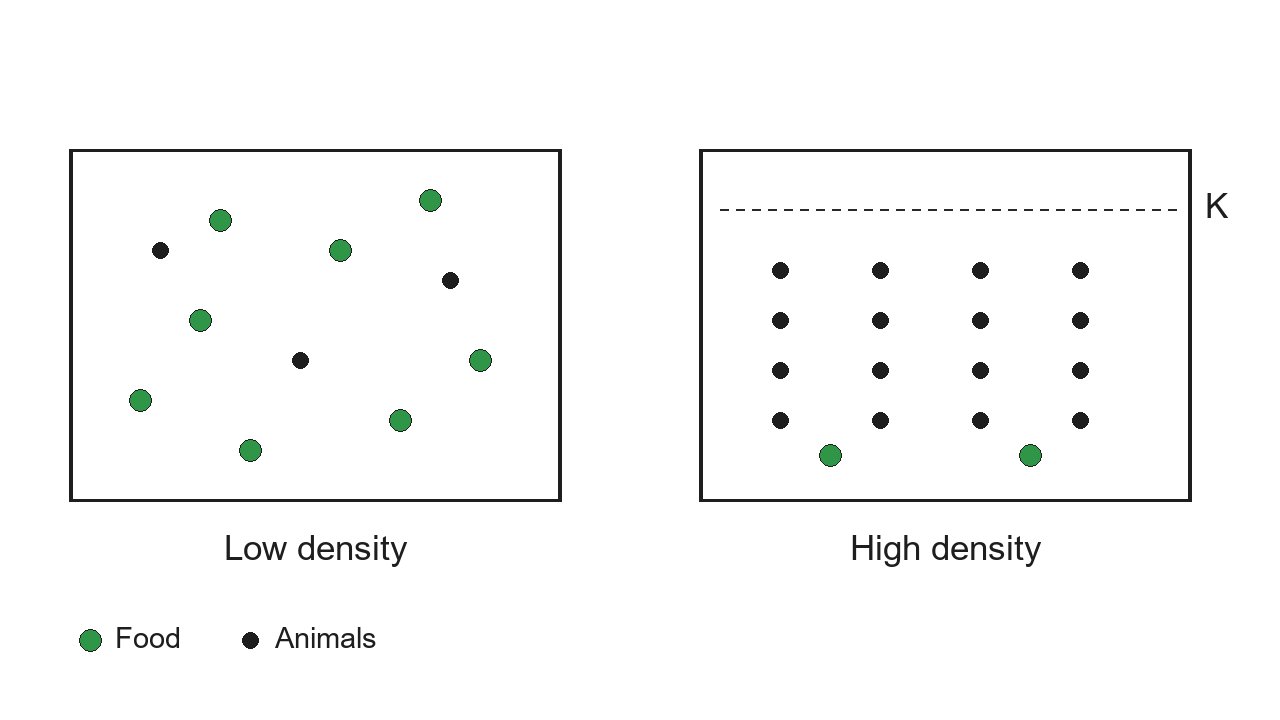
Low density leaves food plentiful relative to the animals. High density crowds the animals and leaves little food. The dashed line is $K$, the size those resources can keep supporting.
Once density-dependent and density-independent limits act, growth follows $\frac{dN}{dt}=r_{\max}N\frac{K-N}{K}$. The factor $\frac{K-N}{K}$ shrinks as $N$ approaches $K$ from below, so growth slows. At $N=K$ the factor is 0 and $\frac{dN}{dt}=0$. If $N$ is above $K$, the factor is negative and the population declines toward $K$. A graph of $N$ versus time is an S-shaped curve that levels near $K$. The product $N(K-N)$ is largest at $N=K/2$, so the steepest rise is near half of carrying capacity.
Worked values: $r_{\max}=0.20$ per year, $N=100$, and $K=400$. Then $\frac{K-N}{K}=\frac{300}{400}=0.75$, and $\frac{dN}{dt}=0.20\times 100\times 0.75=15$ individuals per year. At the midpoint $N=200$, $\frac{dN}{dt}=0.20\times 200\times 0.50=20$ individuals per year, which is faster. At $N=400$, $\frac{dN}{dt}=0$. At $N=500$, $\frac{K-N}{K}=-0.25$, so $\frac{dN}{dt}=0.20\times 500\times(-0.25)=-25$ individuals per year.
| Limit | How it acts | Example |
|---|---|---|
| Density-dependent | The effect strengthens as density rises | Competition for food, or disease that spreads more easily in a crowd |
| Density-independent | The effect does not strengthen just because density is higher | A storm that kills a similar fraction whether nests are sparse or crowded |
Density-independent events still change $N$. They are not irrelevant. They simply do not act through crowding. Together with limited resources, they are why growth leaves the unconstrained exponential pattern and approaches $K$. If resources increase, $K$ can rise. If habitat is lost, $K$ can fall, and the long-term population is expected to settle near the new value.
Key points
- $K$ is set by available resources. It can rise or fall if those resources change.
- Logistic growth: $dN/dt=r_{\max}N(K-N)/K$.
- Example: $r_{\max}=0.20$, $N=100$, $K=400$ gives $dN/dt=15$ individuals per year.
- At $N=K$, $dN/dt=0$. Above $K$, $dN/dt$ is negative.
- The fastest logistic rise is near $N=K/2$.
- Density-dependent limits intensify with crowding. Competition for food is one.
- A density-independent limit, such as a storm, does not get stronger just because density is higher.
Once a problem gives a carrying capacity, use the logistic equation. The factor $\frac{K-N}{K}$ is what slows growth as $N$ nears $K$.