TOPIC 7.8 · STUDY
Continuing Evolution
All species have evolved and continue to evolve. Ongoing change appears in genomes, in the fossil record, in resistance to antibiotics, pesticides, herbicides, or chemotherapy drugs, and in pathogens that cause emergent diseases. A study of continuing evolution needs a baseline so change over time can be measured.
7.8.A
Evolution that is still happening
All species have evolved and continue to evolve. Evolution is not confined to the distant past. Genomic changes over time are direct evidence on a recent scale. Continuous change in the fossil record is evidence on a geological scale. The two scales together show that the process is ongoing.
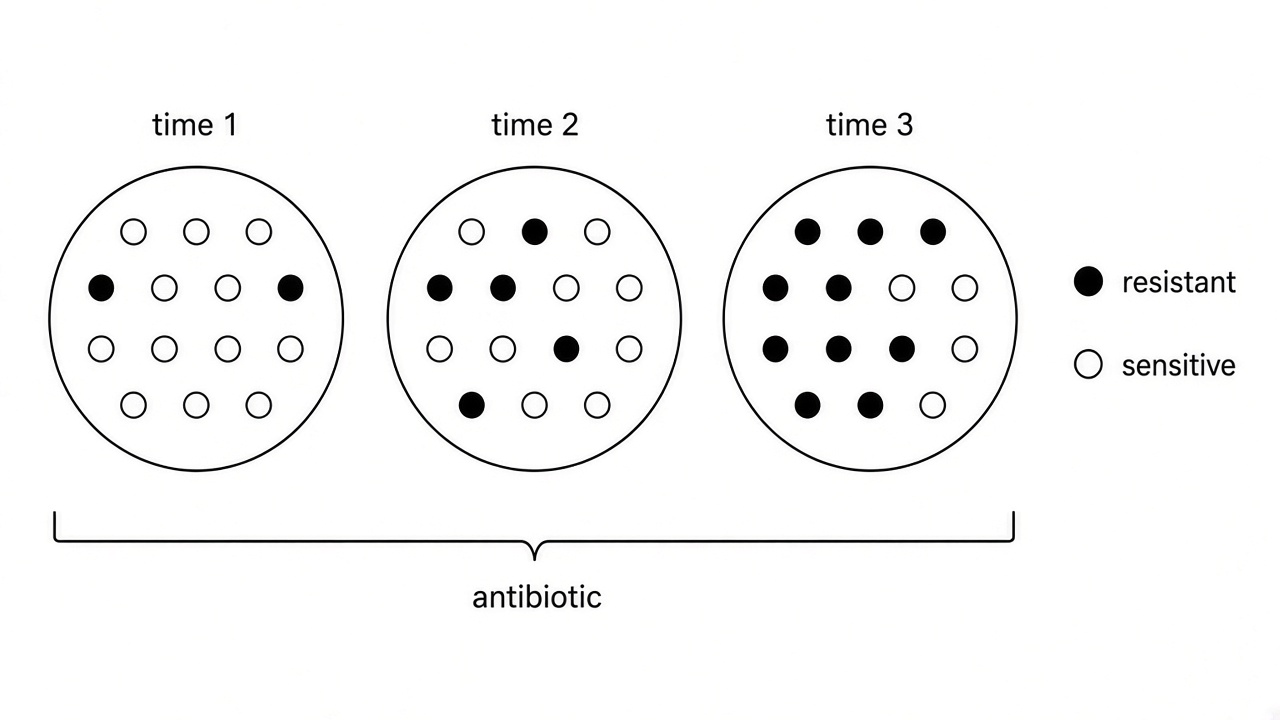
Under continued antibiotic exposure, resistant cells make up a larger share of the population from time 1 to time 3.
Resistance evolution is a repeated modern case. Antibiotics, pesticides, herbicides, and chemotherapy drugs each favor heritable resistant variants. Those variants leave more descendants under treatment, so their frequency rises. The chemical differs. The evolutionary process is the same. Not every individual in a diverse population is susceptible, which is why resistance can spread from variants that were already present.
Pathogens evolve and can cause emergent diseases. Viral genomic change under selective pressure is continuing evolution in the pathogen population. Fossils that change across successive layers, and genomes that change across years, are the same claim on different clocks.
A claim of ongoing evolution needs a comparison across time. One measurement after treatment, with no earlier baseline, cannot show change. A stronger test saves samples from before and after the pressure, or compares treated and untreated groups, and then measures the phenotype or known resistance alleles in a common setting.
Key points
- Every species has evolved, and evolution continues.
- Genomes change on recent timescales. Fossils show change across deeper time.
- Resistance to antibiotics, pesticides, herbicides, or chemotherapy drugs is ongoing selection.
- The chemical differs, but heritable resistant variants increase under that pressure.
- Pathogen evolution can produce emergent diseases.
- Show change by comparing a baseline with later samples, not by one post-treatment measurement.
Resistance spreads because heritable variants that already survive the treatment leave more offspring. The treatment does not create the resistant allele on demand.