TOPIC 7.7 · STUDY
Common Ancestry
Structural and functional evidence supports the common ancestry of all eukaryotes. The shared features in this topic are membrane-bound organelles, linear chromosomes, and genes that contain introns. A cell with a circular chromosome and no membrane-bound organelles does not show that eukaryotic suite.
7.7.A
Shared features of eukaryotes
Structural and functional evidence indicates common ancestry of all eukaryotes. The features used here are membrane-bound organelles, linear chromosomes, and genes that contain introns. These are traits of cell structure and gene architecture, not maps of where organisms live.
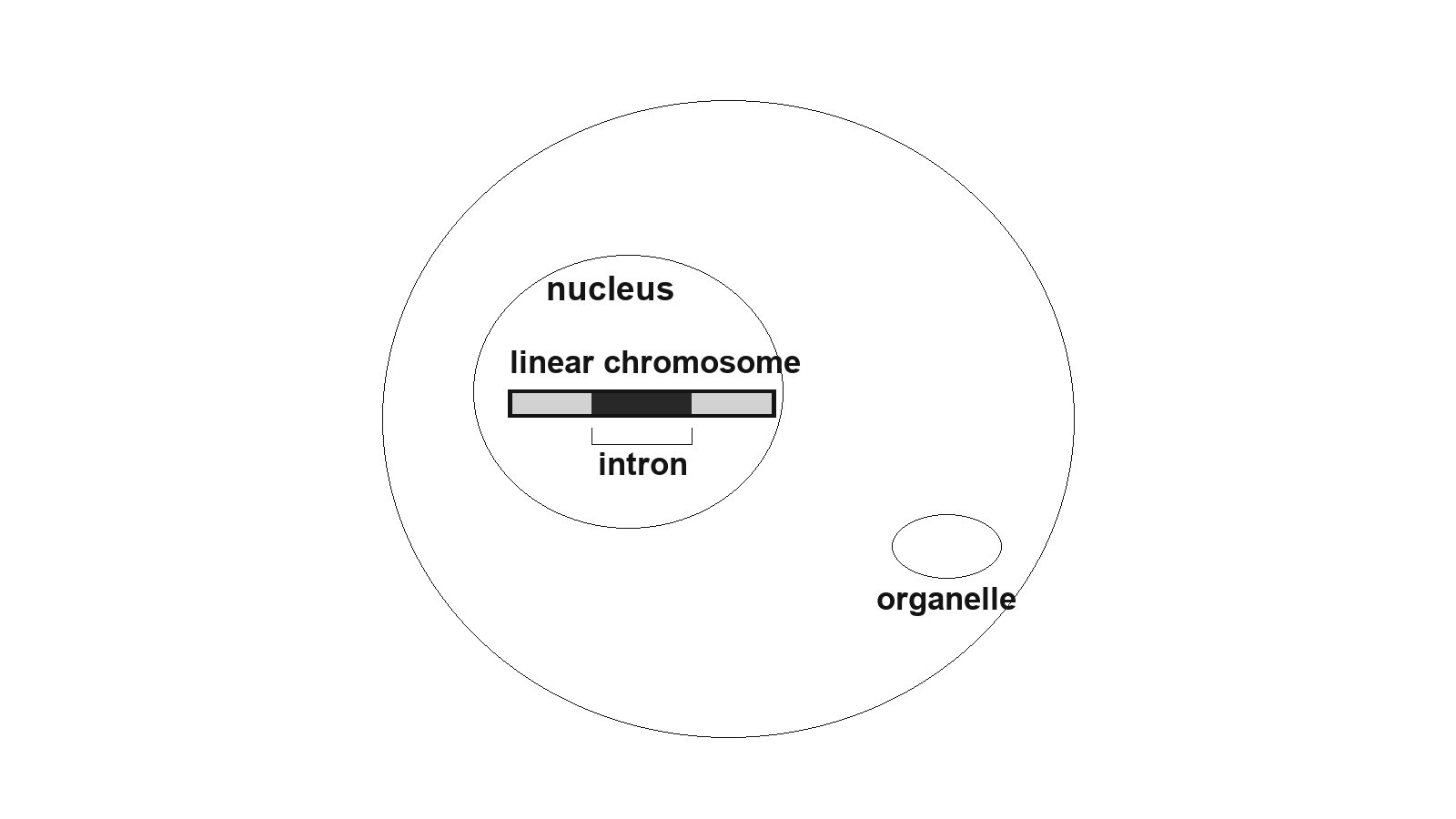
The organelle is membrane-bound and outside the nucleus. The chromosome is linear, and the dark segment is an intron within it.
Membrane-bound organelles, such as a nucleus and mitochondria, are a shared eukaryotic trait. Linear chromosomes organize the eukaryotic nuclear genome. Many bacteria have a circular chromosome instead. Genes that contain introns are also evidence. Introns are noncoding segments inside genes. Related eukaryotes share that gene architecture. If one lineage later loses splicing, the intron history of related eukaryotes is still evidence of ancestry.
Shared complex features are more likely inherited from a common ancestor than built identically in every lineage. Secondary loss in one group does not erase the ancestral presence of organelles. The trait remains evidence for groups that keep it. Loss is a later modification. An organism that lacks membrane-bound organelles, has a circular chromosome, and lacks typical introns does not display this eukaryotic suite.
Introns must be removed for a gene to be expressed correctly. That functional requirement explains why splicing matters. It does not remove intron structure as historical evidence in lineages that still have it.
Key points
- All eukaryotes share evidence of common ancestry at the cell and molecular level.
- Membrane-bound organelles are one part of that evidence.
- Eukaryotic nuclear chromosomes are linear. Many bacteria have circular chromosomes.
- Genes that contain introns are part of the shared eukaryotic pattern.
- These are structural and molecular traits, not geographic distributions.
- Loss of a trait in one lineage is a later change. It does not cancel the evidence in lineages that keep the trait.
The course list for this comparison is organelles, linear chromosomes, and introns. A missing member of that suite is evidence against a eukaryotic identification.