TOPIC 7.6 · STUDY
Evidence of Evolution
Evolution is supported by geographical, geological, physical, biochemical, and mathematical evidence. Fossils are dated from rock ages, isotope decay such as carbon-14, and geographic context. Homologous structures, including vestigial ones, and comparisons of DNA and protein sequences show that living and extinct organisms have changed and share ancestry.
7.6.A
Many kinds of evidence
Evolution is supported by evidence from many disciplines: geographical, geological, physical, biochemical, and mathematical data. Agreement among independent lines is stronger than any one line alone, because each method can be wrong for a different reason.
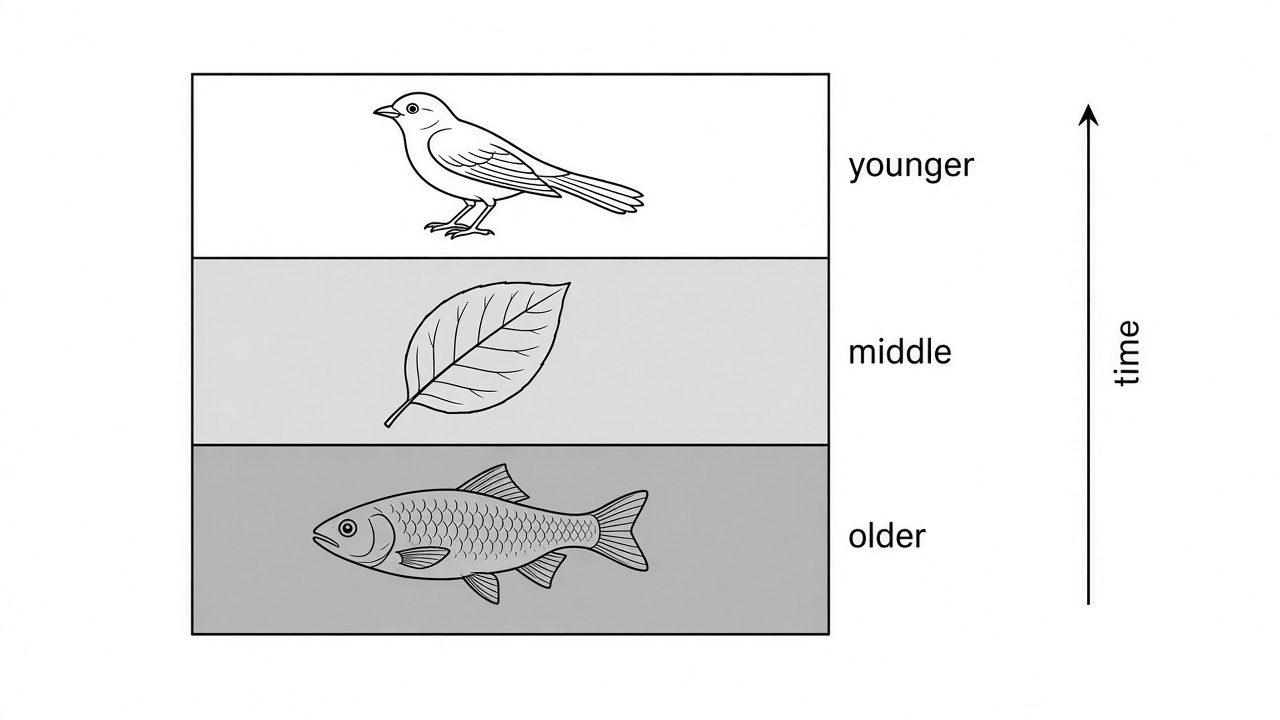
Older rock is drawn below younger rock. Fossils that differ between layers show that life has changed through time.
Geographical data include where related organisms live. Related forms on nearby landmasses can fit divergence after colonization. Geological data include the ages of rocks and the fossils in them. Physical evidence includes body structures. Biochemical evidence includes DNA nucleotide sequences and protein amino acid sequences. Mathematical data include measured changes in genetic makeup. Fewer amino acid differences between two proteins support a closer relationship than either protein has with a third that differs at many more sites.
7.6.B
Fossils, homology, and sequences
Molecular, morphological, and genetic evidence from living and extinct organisms adds to the account of evolution. Fossils can be dated from the age of the rocks where they are found, from the rate of decay of isotopes including carbon-14, and from geographical data about where they were buried. Different organisms in older and younger strata document change over time.
Morphological homologies, including vestigial structures, provide evidence of common ancestry. Homologous structures are shared by inheritance, even when their later functions differ. Vertebrate forelimb bones correspond across groups, while proportions and uses differ. A vestigial structure is a reduced remnant. It fits inheritance from ancestors in which the structure was functional under different conditions.
A comparison of DNA nucleotide sequences and protein amino acid sequences provides evidence for evolution and common ancestry. Fewer differences support a more recent split. More differences support a deeper split. A large difference does not mean the organisms are unrelated. Distant common ancestry predicts more differences, not zero relatedness.
| Dating clue | What it uses |
|---|---|
| Rock age | The layer in which the fossil is found |
| Isotope decay | The decay rate, including carbon-14 where it applies |
| Geography | The place and setting in which the fossil was buried |
Key points
- Geographical, geological, physical, biochemical, and mathematical data all support evolution.
- Agreement among independent lines is stronger than one line alone.
- Fossil dates come from rock ages, isotope decay including carbon-14, and geographic context.
- Different fossils in older and younger layers show change over time.
- Homologous structures, including vestigial ones, indicate common ancestry with modification.
- Shared inherited structure is the evidence. Similar use by itself is not homology.
- Fewer DNA or amino acid differences indicate a closer relationship. Many differences indicate a deeper split.
A large sequence difference is evidence of deeper divergence. It is not evidence that the organisms lack a common ancestor.