TOPIC 7.5 · STUDY
Hardy-Weinberg Equilibrium
The Hardy-Weinberg model predicts allele and genotype frequencies in a non-evolving population. It requires a large population, no migration, no new mutation, random mating, and no natural selection. Those conditions are the null hypothesis. Allele frequencies can be counted from genotypes, and genotype frequencies can be predicted from allele frequencies. A chi-square comparison uses 1 degree of freedom and a critical value of 3.84 at alpha 0.05.
7.5.A
The non-evolving null model
The Hardy-Weinberg equilibrium is a model for describing and predicting allele frequencies in a non-evolving population. The conditions are a large population size, no migration, no new mutations, random mating, and no natural selection. Real populations do not meet every condition, but the model is the null hypothesis. If the data depart from the prediction, at least one evolutionary process is likely acting. A flat allele frequency over time fits little net change, though opposing forces can also cancel.
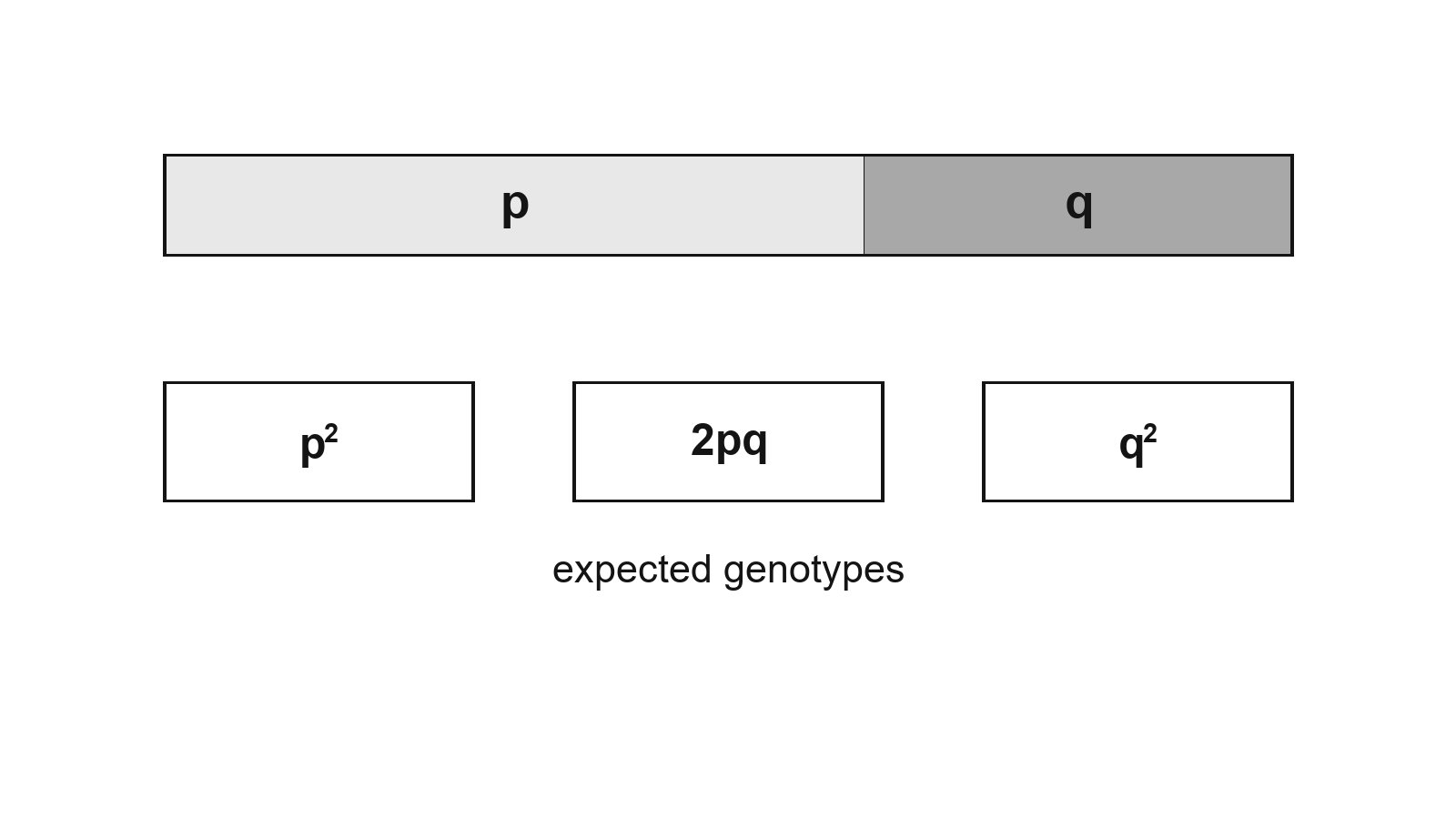
The bar is the two allele frequencies. The boxes are the expected genotype frequencies for a random-mating, non-evolving population.
For a gene with two alleles, let p be the frequency of one allele and q the frequency of the other. Then $p+q=1$ and $p^{2}+2pq+q^{2}=1$. The three terms are the expected frequencies of the two homozygotes and the heterozygote. If the recessive homozygote frequency is 0.04, q is the square root of 0.04, so q = 0.2 and p = 0.8. The expected frequencies are 0.64, 0.32, and 0.04.
Allele frequency can also be counted from individuals. Each homozygote contributes two copies of its allele, and each heterozygote contributes one. With 40 AA, 40 Aa, and 20 aa, there are 100 individuals and 200 allele copies. Copies of A = 2(40) + 40 = 120, so p = 0.60 and q = 0.40. Expected counts are 36 AA, 48 Aa, and 16 aa. Chi-square is the sum of (observed minus expected) squared, divided by expected: 16/36 + 64/48 + 16/16, which is about 2.78.
For two alleles, after p is estimated from the sample, degrees of freedom equal 1. There are three genotype classes, one constraint that frequencies sum to 1, and one estimated allele frequency. At alpha = 0.05 the critical value is 3.84. A chi-square of 2.78 is below 3.84, so this sample does not give strong evidence against Hardy-Weinberg proportions. Do not use 5.99, the critical value for 2 degrees of freedom. Migration that brings a different allele frequency, selection, mutation, nonrandom mating, or a small population each violates the null.
| Condition | What the null requires |
|---|---|
| Population size | Large enough that chance sampling does not shift frequencies |
| Migration | No alleles enter or leave |
| Mutation | No new mutations |
| Mating | Random with respect to this gene |
| Selection | No phenotype has higher reproductive success |
Key points
- Hardy-Weinberg equilibrium is the null model for a non-evolving population.
- Conditions: large population, no migration, no new mutation, random mating, and no selection.
- The conditions are not fully met in nature, but they are the prediction used for comparison.
- $p+q=1$ and $p^{2}+2pq+q^{2}=1$. p and q are the two allele frequencies.
- The three genotype terms are the expected frequencies of both homozygotes and the heterozygote.
- Count alleles from genotypes: a homozygote contributes two copies and a heterozygote contributes one.
- For this test, degrees of freedom equal 1 and the 0.05 critical value is 3.84, not 5.99.
A chi-square below 3.84 does not prove every condition holds. It means this sample does not strongly contradict the expected proportions.