TOPIC 2.10 · STUDY
Origins of Cell Compartmentalization
Mitochondria and chloroplasts arose by endosymbiosis, when free-living prokaryotic cells were taken into a host and became organelles. Typical prokaryotes lack internal membrane-bound organelles but still have specialized internal regions. Eukaryotes use internal membranes to divide the cell into specialized regions.
2.10.A
Endosymbiosis and two kinds of compartment
Endosymbiosis is the evolutionary origin of two organelles. Mitochondria and chloroplasts came from prokaryotic cells that once lived on their own. A host cell took one in, kept it, and the guest became a membrane-bound organelle rather than food. Chloroplasts are explained the same way, starting from a photosynthetic prokaryote. Both organelles function inside eukaryotic cells. They are not free-living organisms now.
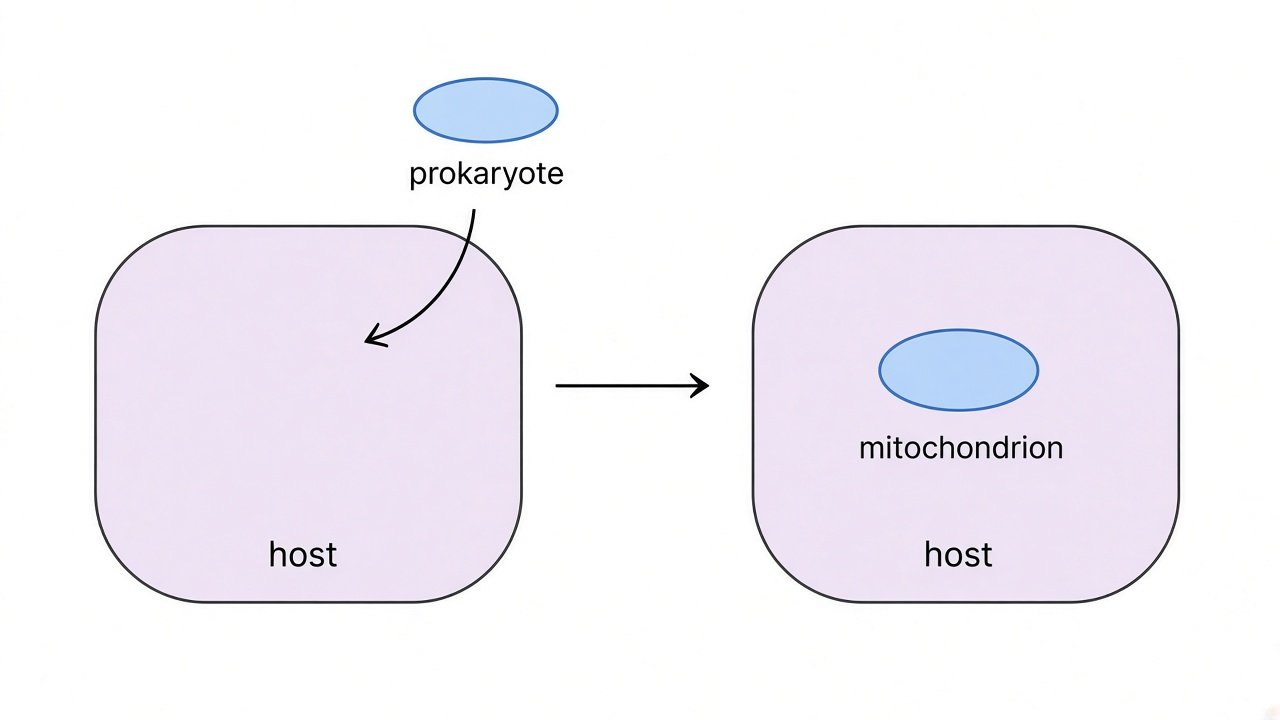
A free-living prokaryote is taken into a host cell. In the later cell, that internalized prokaryote is a mitochondrion.
A double membrane fits that history at a structural level. The inner membrane corresponds to the membrane of the engulfed cell. The outer membrane corresponds to the membrane wrapped around it during engulfment. The figure shows the sequence for a mitochondrion: a small prokaryote outside the host, then a mitochondrion inside the host. The claim is about origin. It does not say that a modern mitochondrion is still an independent cell.
Typical prokaryotes lack internal membrane-bound organelles. They are not featureless. They have internal regions with specialized structures and functions, such as a region where the chromosome is concentrated, without a membrane sealing that region off as its own organelle. Some prokaryotes fold the plasma membrane inward and gain surface for reactions. That fold is still part of the plasma membrane. It is not a separate compartment bounded by its own membrane the way a mitochondrion is.
Eukaryotic cells maintain internal membranes that partition the cell into specialized regions. That is the compartmentalization difference. A plant leaf cell has mitochondria and chloroplasts as membrane-bound organelles. A typical bacterium does not. Both kinds of cell have a plasma membrane and ribosomes. The feature this topic adds for eukaryotes is the internal membrane system, including organelles that endosymbiosis explains.
Key points
- Mitochondria and chloroplasts evolved from once free-living prokaryotes by endosymbiosis.
- A host cell retained an engulfed prokaryote, and that prokaryote became an organelle.
- A double membrane is consistent with one cell having been engulfed by another.
- Prokaryotes typically lack internal membrane-bound organelles but have specialized internal regions.
- Infolded plasma membrane in a prokaryote is not the same thing as a separate membrane-bound organelle.
- Eukaryotes partition the cell with internal membranes into specialized regions.
- Endosymbiosis explains an origin of eukaryotic compartments. Modern mitochondria and chloroplasts are organelles, not free-living cells.
Stay with the structural comparison. The molecular details of how those organelles copy their own DNA are outside this topic.