TOPIC 1.2 · STUDY
Elements of Life
Organisms build carbohydrates, proteins, lipids, and nucleic acids from atoms taken in from the environment. Carbon, hydrogen, and oxygen are the most common of those atoms. Sulfur is used in proteins, phosphorus in phospholipids and nucleic acids, and nitrogen in nucleic acids.
1.2.A
Elements of life
Living systems do not create new chemical elements. They assemble molecules from atoms already present in food, water, air, or soil. Carbon, hydrogen, and oxygen are the most prevalent elements in carbohydrates, proteins, lipids, and nucleic acids. A storage fat, for example, can be built mostly from those three and still match that pattern. Three other elements are tied to particular classes. Sulfur is used in building proteins. Phosphorus is used in phospholipids, which are a type of lipid, and in nucleic acids. Nitrogen is used in building nucleic acids. Proteins also contain nitrogen in their amine groups. The additional element this topic names for proteins is sulfur.
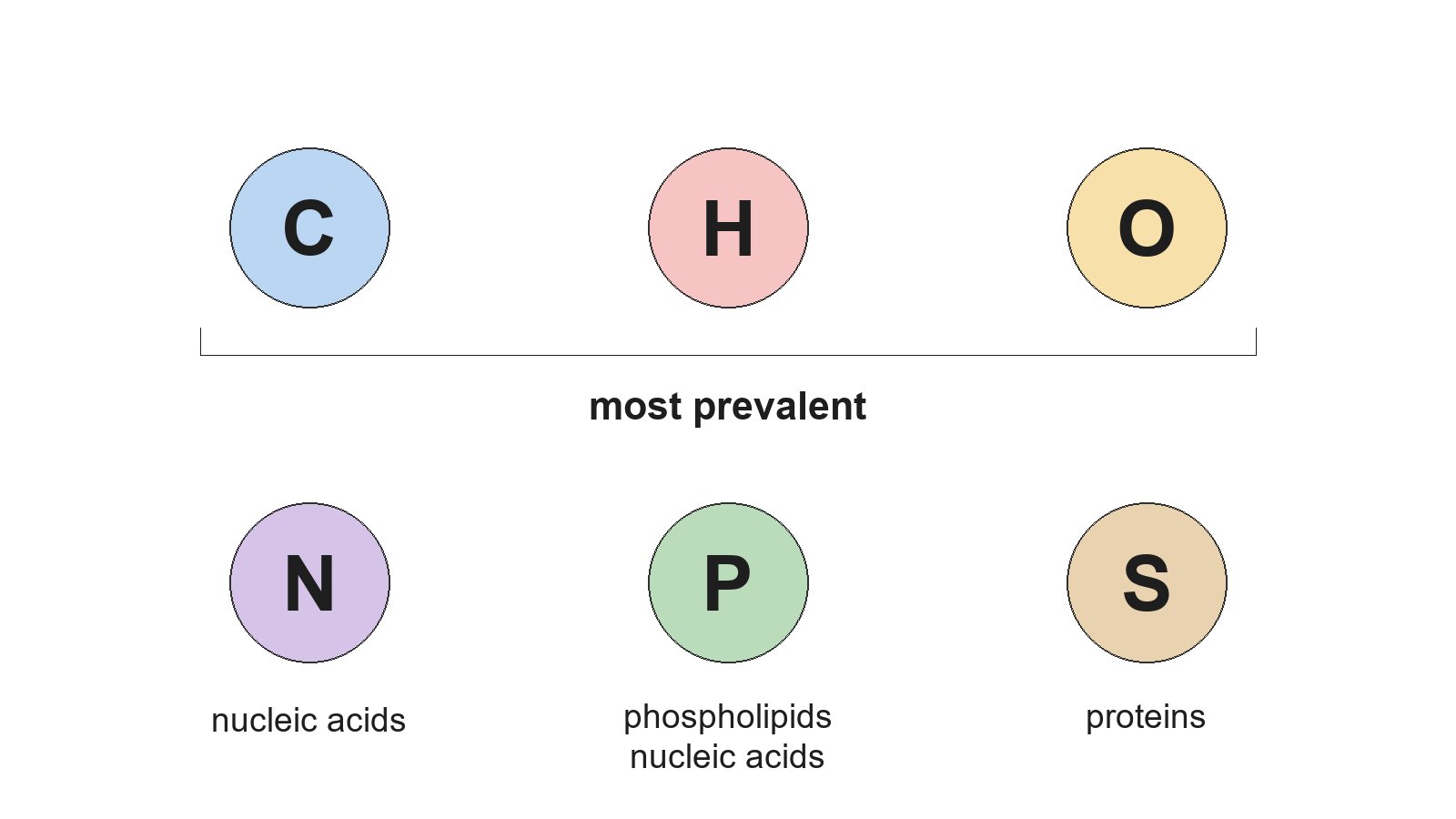
The bracket groups carbon, hydrogen, and oxygen as the most prevalent elements in biological molecules. The lower labels give the classes that require nitrogen, phosphorus, or sulfur.
| Element | Used to build |
|---|---|
| Carbon, hydrogen, and oxygen | Carbohydrates, proteins, lipids, and nucleic acids |
| Sulfur | Proteins |
| Phosphorus | Phospholipids and nucleic acids |
| Nitrogen | Nucleic acids |
If one of those elements is missing, only the molecules that need it are blocked. A growth medium without phosphorus limits nucleic acids and membrane phospholipids together. A shortage of sulfur limits proteins more directly than it limits starch, because starch is a carbohydrate built from carbon, hydrogen, and oxygen. A shortage of nitrogen limits nucleic acid synthesis. Collecting carbon from food, or from carbon dioxide, is still taking in carbon atoms that already exist. It does not create the element carbon.
Key points
- New biological molecules are assembled from atoms taken in from the environment.
- Carbon, hydrogen, and oxygen are the most prevalent elements in all four macromolecule classes.
- Sulfur is used to build proteins.
- Phosphorus is used to build phospholipids and nucleic acids.
- Nitrogen is used to build nucleic acids.
- A missing element blocks the macromolecules that require it, not every class equally.
The symbols in the figure are a checklist of inputs. They do not mean every molecule contains every element. A carbohydrate does not require sulfur or phosphorus.