TOPIC 1.3 · STUDY
Introduction to Macromolecules
Hydrolysis uses water to break a covalent bond, adding H to one monomer and OH to the other. Dehydration synthesis removes the equivalent of a water molecule and joins the remaining parts with a new covalent bond. Repeating that joining builds a polymer.
1.3.A
Hydrolysis and dehydration synthesis
Biological macromolecules are built and broken by two opposite reactions that both involve water. Hydrolysis cleaves a covalent bond. Water is a reactant. A hydrogen from that water is added to one monomer, and the hydroxyl group is added to the other. The larger molecule becomes smaller pieces. Breaking a food polymer apart in watery surroundings is hydrolysis: the covalent links open and the monomers separate.
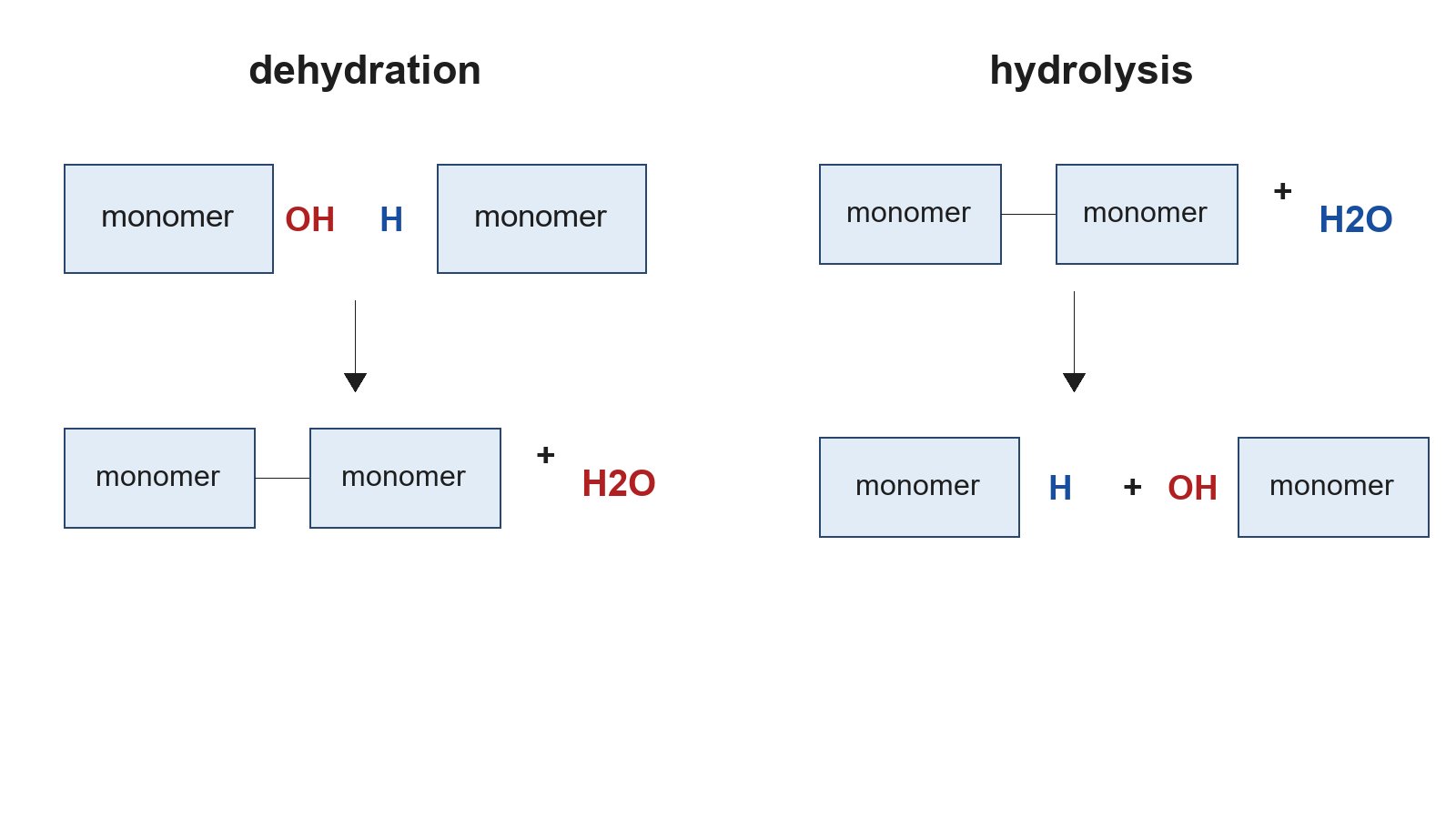
In dehydration, OH leaves one monomer and H leaves the other. The monomers connect, and H2O is released. In hydrolysis, H2O is a reactant. The link breaks, one monomer gains H, and the other gains OH.
Dehydration synthesis runs the other way. A hydrogen is removed from one monomer and a hydroxyl group is removed from the other. Those pieces leave as one water molecule, and a covalent bond forms between what remains. Connecting many monomers by repeated dehydration is polymerization. Count the links, not the monomers. A straight, unbranched chain of 8 monomers has 7 covalent links. Building that chain releases 7 water molecules. Hydrolyzing every link consumes 7 water molecules and returns 8 separate monomers.
Cells use dehydration when they assemble polymers and hydrolysis when they take polymers apart and reuse the pieces. If dehydration is blocked, new chains stop growing even though existing chains can still be broken. If hydrolysis is blocked, polymers stay intact and the supply of free monomers falls. The two reactions are not the same process with water nearby. Water is produced when the covalent bond forms and consumed when that bond is cleaved.
Key points
- Hydrolysis breaks a covalent bond by adding water: H to one monomer and OH to the other.
- Dehydration synthesis removes H from one monomer and OH from the other, then joins what remains.
- The water released in dehydration is the H and OH that were removed.
- Polymerization is the linking of many monomers, usually by repeated dehydration.
- A linear chain of n monomers has n - 1 links.
- Building those links releases water. Breaking all of them consumes the same number of water molecules.
Both reactions involve water, but the water balance is opposite. Hydrolysis consumes water and shortens the chain. Dehydration produces water and lengthens the chain.