TOPIC 1.1 · STUDY
Structure of Water and Hydrogen Bonding
Water is polar because oxygen and hydrogen share electrons unequally inside each molecule. Hydrogen bonds between molecules give water a high specific heat, a high heat of vaporization, cohesion, adhesion, and surface tension. Living systems use those properties to buffer temperature, cool by evaporation, and move water.
1.1.A
Structure of water and hydrogen bonding
A water molecule, $\mathrm{H_2O}$, is held together by polar covalent bonds. Oxygen keeps the shared electrons closer, so the oxygen end is partially negative ($\delta^-$) and each hydrogen is partially positive ($\delta^+$). The molecule is bent, so the partial charges do not cancel. A hydrogen bond is a different attraction: a partially positive hydrogen on one molecule is drawn to a partially negative atom on another molecule, usually oxygen. That attraction is weaker than the covalent bonds inside one molecule. The same partial charges let water form hydrogen bonds with polar parts of other biological molecules.
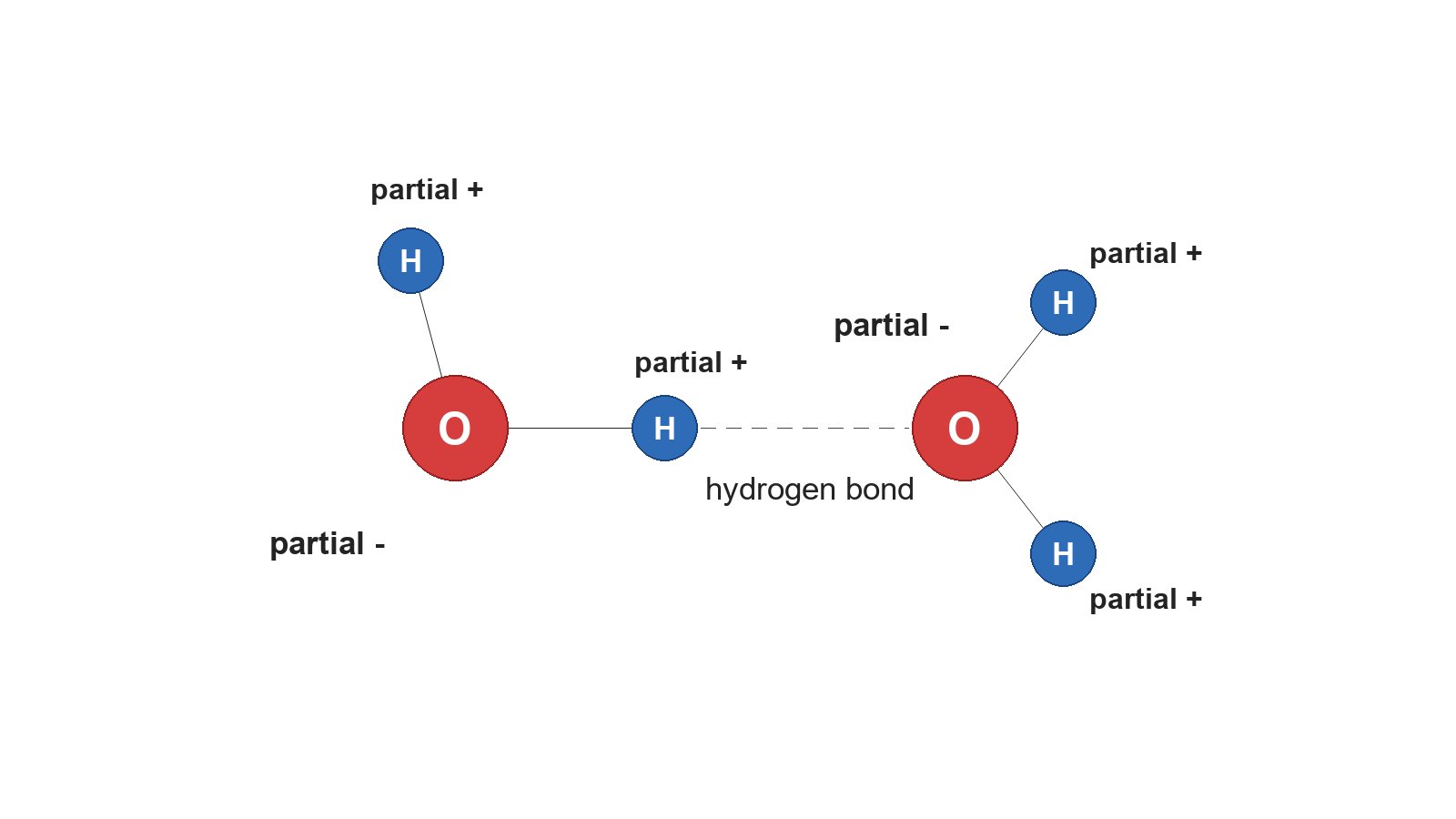
The solid lines are covalent bonds inside each water molecule. The dashed line is a hydrogen bond between molecules, from a partially positive hydrogen to a partially negative oxygen.
Breaking those hydrogen bonds takes energy, so water has a high specific heat capacity. If equal masses of water and dry sand absorb the same amount of heat, the water's temperature rises less. Water in body fluids, and water in a lake, can take in or release heat with only a modest temperature change. That stability helps an organism hold a steady body temperature. Water also has a high heat of vaporization. Molecules that leave as vapor carry away a large amount of energy. When sweat evaporates, the liquid left on the skin is cooler. That is evaporative cooling. If the air is already humid, evaporation slows and the cooling is weaker.
Cohesion is hydrogen bonding between water molecules. Adhesion is hydrogen bonding between water and a different polar surface. At the surface, cohesion resists stretching and produces surface tension, which can support a light insect. In a narrow tube with a polar wall, adhesion to the wall and cohesion inside the liquid pull water upward. The same pair of attractions can keep a water column continuous in a plant. If the wall becomes less polar, adhesion falls and the column is easier to break. Surface tension is not caused by the covalent bonds inside one $\mathrm{H_2O}$. Those bonds hold each molecule together. The attractions between molecules cause the surface behavior.
Key points
- Polar covalent O-H bonds make oxygen $\delta^-$ and hydrogen $\delta^+$.
- A hydrogen bond links a hydrogen on one molecule to an oxygen on another, or to another polar group.
- High specific heat: water's temperature changes slowly, which helps hold body temperature steady.
- High heat of vaporization: evaporating water removes heat and cools the body.
- Cohesion is water-water attraction. Adhesion is attraction between water and another surface.
- Surface tension is cohesion at the air-water surface.
- Capillary rise and a continuous water column use adhesion and cohesion together.
The covalent bond inside a water molecule and the hydrogen bond between molecules are not the same bond. Weakening only the hydrogen bonds would weaken temperature buffering, evaporative cooling, and surface tension.